
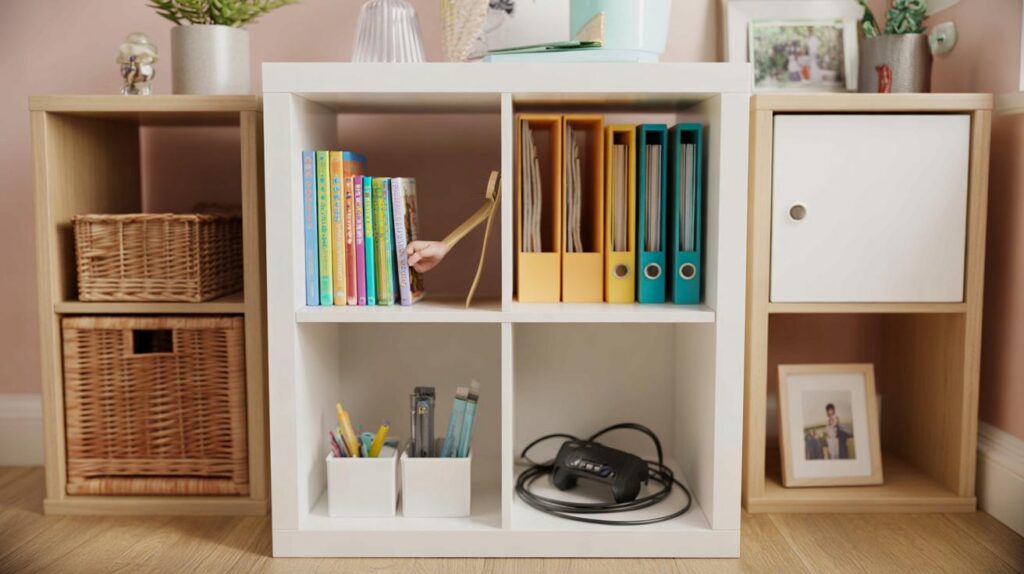
Big furniture names don’t often lose ground, yet a tiny add-on is nudging households towards slimmer, smarter storage.
Across flats, terraces and family homes, the conversation is shifting from tall bookcases to modular cubes. A £19 IKEA insert, designed for Kallax, is quietly changing how people store books, toys and paperwork without giving up precious floor space.
Why parents are rethinking Billy
Billy built its reputation on simplicity and price. It stands, it holds, it blends in. But many UK homes battle awkward alcoves, narrow landings and rooms doing double duty as office, nursery or guest space. When the footprint can’t grow, flexibility takes the lead.
This is where the Kallax insert with four shelves steps in. It transforms a single 33 x 33 cm cube into four smaller cubbies. That grid brings order to small items that usually sprawl: paperbacks, colouring books, mail, chargers, even vinyl sleeves. You add or remove inserts one cube at a time, so your storage evolves as your life shifts.
One £19 insert turns a single Kallax cube into four tidy slots, with zero extra floor space used.
Parents like that they can create a reading corner in one cube, an admin station in another and toy rotation in a third, without buying a whole new unit. If a bedroom becomes a study, the inserts move with you.
What the £19 insert actually does
The insert comes in a neutral white finish and slots into any standard Kallax cube. The assembly is straightforward: think basic screws, a screwdriver and a cuppa’s worth of time. No epic Allen key session, no floor full of dowels. Once fitted, you get four equal compartments that feel purpose-built for everyday clutter.
- Files and school papers sit upright if you rotate the insert to make vertical slots.
- Children’s books face forward for easy choosing and quick tidy-up.
- Magazines stack flat without curling; craft supplies stay separated.
- Records, controllers and cables gain a home that isn’t a tangled basket.
Because it hides inside the Kallax frame, you keep a clean silhouette. You can scatter inserts across a 2×4 Kallax to mix cubbies with baskets, doors and open display space.
Mix, match and reconfigure one cube at a time. No need to scrap or shift a whole bookcase.
The numbers that matter for small homes
When every square metre counts, modular wins. A Kallax cube is already compact, and the insert multiplies its usefulness. You gain four smaller homes inside the footprint you already own.
| Feature | Billy bookcase | Kallax + 4-shelf insert |
|---|---|---|
| Footprint | Tall, fixed width and depth | Cube-based, expands horizontally or vertically |
| Reconfiguration | Move shelves, but full unit stays | Add or remove inserts per cube as needs change |
| Assembly burden | One larger build | Short, modular sessions per cube |
| Visual style | Traditional bookshelf lines | Clean grid, adaptable with doors, baskets, boxes |
| Moving house | Awkward through tight stairwells | Breaks down into lighter pieces and inserts |
If you already own Kallax, a single £19 insert can upgrade a corner without adding furniture. Buy two inserts and you’ve created eight micro-shelves across two cubes. Spread them out in a 2×2 or 2×4 unit and you get a pleasing rhythm of grid, basket and open display that looks more curated than a wall of spines.
Style without stress
The insert maintains the calm, boxy lines that make Kallax a rental favourite. In white, it blends with most skirtings and paint colours. Pair with natural baskets for warmth, bold folders for a home office, or pastel boxes for a nursery. The look shifts with your accessories rather than your furniture.
Because the compartments are smaller, they limit clutter creep. Each slot sets a boundary: four school subjects, four types of Lego, four craft categories. Limits help families tidy quickly because there’s a clear “home” for everything.
Safety and setup tips that save headaches
Anchor tall Kallax units to the wall, especially in rooms used by children. Spread heavier items across lower cubes. Keep the insert loaded evenly to prevent shelf bowing. Add felt pads under baskets so they slide smoothly and don’t snag little fingers.
Secure first, style second. A discreet wall fixing and a sensible weight plan keep modular storage family-friendly.
If you like vertical filing for paperwork, rotate the insert so each slot runs top to bottom. Use slim magazine files to stop papers slumping. Label the top edge of each slot so adults and kids can return items to the right place without guessing.
Real-life setups you can copy today
Small hallway: one cube with an insert for post, returns, keys and umbrellas. Another cube stays open for shoes. Add a tray on top for coins and cards.
Shared office-spare room: two inserts across a 2×2 unit create eight slots. Assign them to home admin, school letters, printer paper, chargers, receipts, manuals, stationery and a “to action” tray. Keep the remaining cubes open for guest towels and a spare pillow.
Children’s bedroom: place inserts at child height. Group by activity—reading, drawing, building, role play. Rotate what’s on show each term to renew interest and keep piles under control.
Who should still pick Billy
If you own many tall hardbacks, art books or big board games, a traditional shelf can line them up neatly. A Billy wall also suits renters who can’t anchor larger units and prefer a slimmer profile where cubes would protrude too far. Those who love a library feel may still prefer those long, continuous shelves.
The point isn’t to bin Billy; it’s to admit that some homes need storage that grows sideways, breaks down small for moving day and splits space into smaller, more useful bites.
Buying smarter: questions to ask before you spend
- What actually clutters this room: paper, toys, craft, tech or clothes?
- Do I need open access for kids, or doors for visual calm?
- Which cubes should be inserts, and which should stay open for baskets?
- Can I label the slots so family members can tidy without help?
- Where will the heaviest items live to keep the unit stable?
Extra tips to stretch that £19 further
Try a “four-by-four” rule when using one insert: assign each slot to a single theme and cap the volume. When a slot fills, something leaves. This prevents overflow into other cubes. For adults, a monthly five-minute reset—recycle old post, file receipts, retire outgrown toys—keeps the system from drifting.
If you’re on a tight budget, begin with one insert in the messiest cube. Notice what becomes easier: quicker school mornings, less desk clutter, faster toy tidy-ups. Use that win to decide where the next £19 goes. Over time, a few inserts scattered across the home can beat a single new bookcase because they tackle clutter where it actually starts.
For renters and frequent movers, pack inserts flat with a roll of labels and a small screw pouch. Rebuild in your next place in under half an hour, then relabel. The continuity helps families settle fast, even when the floor plan changes.
Small, modular changes often beat big furniture buys: start with one cube, measure the impact, then scale.



£19 to turn one cube into four? That’s the kind of upgrade I’ll actually use.
Genuine question: for art books and LPs, do the compartments end up too tight? I like the idea, but I worry about bowing shelves and scuffed sleves.