
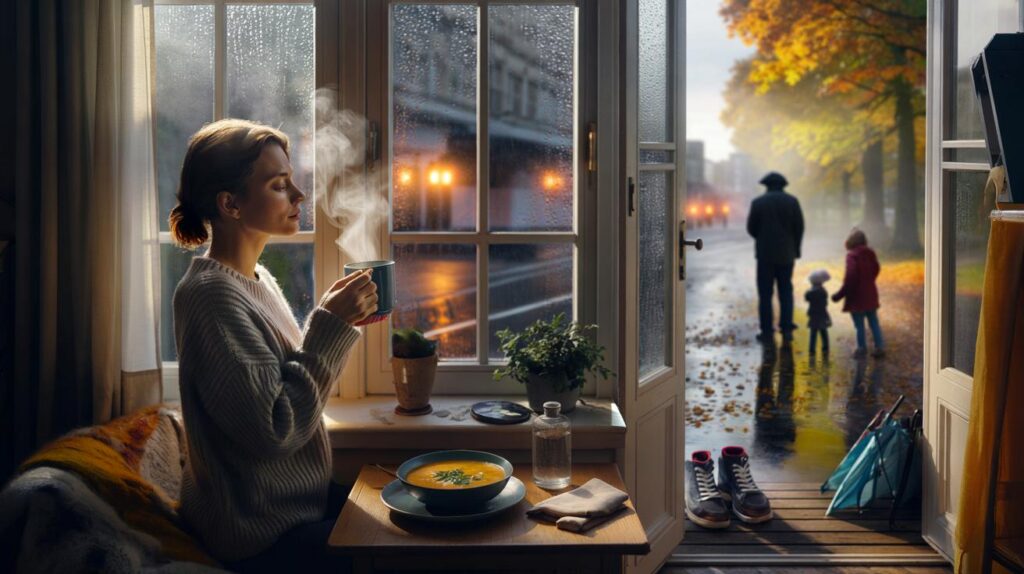
Summer fades, the light tilts, and life quietly accelerates. Diaries fill with parents’ evenings, end-of-year targets, and damp coats hung on every chair. Your body wants to slow down, yet your inbox ramps up. That tug-of-war is where balance slips.
On an October morning in Manchester, I watched commuters breathe steam into the crisp air as the bakery windows fogged over. Bus lights blinked through drizzle, and every hand clutched a hot drink like a small, private ritual. **The weather shifts, but our calendars rarely get the memo.** We’ve all had that moment when you power-walk past your own needs to make an 8.30 meeting and feel oddly hollow by lunch. A neighbour waved, sleeves rolled, sorting conkers with her kids on the pavement, and the scene felt almost medicinal. There’s a softness to autumn that invites a different pace. Balance might be simpler than it looks.
Why autumn rattles your rhythm
Autumn alters the light, and light alters you. Melatonin creeps in earlier, cortisol gets jumpy, and your internal clock drifts like a late bus. Social energy changes too, with school runs, darker commutes, and the low hum of “finish the year strong” following you from the office to the sofa. Your brain is taking in new cues every hour—shorter days, cooler mornings, richer meals—and trying to make sense of them. Keep doing summer habits in an October body and you end up frazzled, not failing. Just mis-timed.
In London, daylight shrinks by roughly three hours between late September and late November, and your attention shrinks with it. I think of Maya, a project manager who told me she felt “foggy by 3pm, wired by 10pm.” She wasn’t broken; she was de-synchronised. She started walking ten minutes after breakfast, coat zipped, face in the open air, and her sleep quietly improved. No miracle. Just rhythm catching up with reality.
Self-care in autumn isn’t spa days and scented candles, useful as they can be. It’s timing, friction and fuel. Your brain loves anchors: a morning light cue, a predictable snack, a consistent cut-off for screens. Design them now and you’ll spend less willpower later. Think of your day as a small system—input light, output energy; input movement, output mood. When the environment changes, the system needs retuning. That’s not indulgence. That’s engineering.
Your practical autumn self-care checklist
Try the 20–5–1 rule for the next two weeks. Twenty minutes of outdoor light within two hours of waking—cloudy still counts, windows don’t. Five minutes of movement “snacks” dropped into your day—stairs, lunges, a brisk lap round the block before your next call. One micro-connection that isn’t online—say hi to the barista, text a friend voice note, sit five minutes with someone you live with. **Think of it as scaffolding, not shackles.** The order matters less than the consistency. Let the season set a gentler metronome.
Common traps? Going all-in for a perfect reset, then crashing by Thursday. Or stockpiling complex recipes when your evenings are a blur of homework and half-damp socks. Start smaller than your pride wants—two litres of water before dinner, protein at breakfast, screens down at 10pm, not 11. *Let the floor be low, the rhythm steady.* Warm foods help your nervous system feel safe—soup, porridge, roasted veg—so keep them ready. Let’s be honest: nobody really does this every day.
When you feel the slump hit, pause and choose one lever: light, move, or connect. Your brain just needs a clear signal, not a grand gesture.
“Light is the body’s loudest calendar. Give it a morning headline.” — Dr. Nadiya Shah, sleep clinician
- Park your morning brew by the brightest window; sip it facing outside.
- Batch a Sunday soup; freeze two portions for late meetings.
- Keep rain-friendly trainers by the door for five-minute walks.
- Write a “polite no” script and stash it in your Notes app.
- Set a 9.30pm wind-down alarm; dim lights, quiet the house.
Staying steady when life speeds up
Autumn balance isn’t a single habit; it’s a conversation with your week. Some days you’ll nail the morning light and miss the stretch. Others you’ll eat toast at 10pm and laugh about it tomorrow. Notice what recharges quickly and what lingers. Swap late-night emails for a five-minute plan for the next morning. Swap the doomscroll for rain-on-window audio and a book you actually like. **Balance isn’t a prize; it’s a practice.** Share what works with a friend and steal one of theirs. It all counts.
| Point clé | Détail | Intérêt pour le lecteur |
|---|---|---|
| Morning light first | 20 minutes outdoors soon after waking to anchor circadian rhythm | Better energy by day, easier sleep at night |
| Movement snacks | Three to five mini-bursts of activity spread across work blocks | Mood lift without long workouts or extra time pressure |
| Warm, simple fuel | Batch soups, protein at breakfast, less caffeine after 2pm | Steadier focus and fewer afternoon crashes |
FAQ :
- How do I beat the 3pm slump without another coffee?Step outside for five minutes, even if it’s grey. Pair it with a protein snack—yoghurt, nuts, cheese—and a tall glass of water. Your brain reads light and amino acids as “we’re safe; carry on.”
- Do I need a SAD lamp, or is daylight enough?Daylight wins when you can get it. If mornings are dark or your schedule is tight, a 10,000-lux lamp used for 20–30 minutes after waking can help. Place it slightly to the side, not straight on.
- What if I work shifts?Give your body a cue at the start of each “day,” even at odd hours—bright light, movement, protein. Use blackout curtains and quiet rituals to bookend rest. Treat rhythm as relative, not perfect.
- How do I say no to back-to-back social plans?Use one honest line: “That week’s full for me—could we do a daytime coffee the week after?” Your calendar is a boundary in disguise. Protect white space like you would a meeting.
- What foods actually help in autumn?Think warm and steady: oats, lentils, eggs, root veg, tinned fish, citrus. Salt your water a pinch if you’re light-headed. Keep treats, just pair them with fibre or protein.



I tried the 20–5–1 rule this week; two ten‑minute light walks before 9am and a quick staircase sprint between calls. Definately felt less foggy by 3pm—thanks for something doable.
Any evidence that morning light beats a SAD lamp in Manchester gloom? I’m not conviced. Links to studies would help, otherwise this reads like wellness common sense dressed up as science.