
Short days, cold nights and cosy routines add up behind one door you rarely suspect. Your bills know exactly where.
We crunched the numbers in the bathroom, tested quick-switch habits, and found cuts that halve water and electricity for many households. The savings are immediate, the kit is cheap, and the comfort stays put. Here is how the smallest room quietly burns money—and how to stop it.
Why the bathroom tops your bills
Hot water, not your oven, is the stealthy budget killer. A standard shower uses 60 to 80 litres, while a quick wash needs less than 10 litres. Every litre you heat draws energy. Add heated towel rails, hair dryers and a collection of bottled products, and this compact space outpaces your kitchen for both energy use and waste.
The hot water trap
Heating water dominates bathroom energy. Raising one litre from 10°C to 40°C uses about 0.035 kWh. Linger under the spray and the cost climbs fast. Take 40 litres off each shower and you trim roughly 1.4 kWh of heating. At 28p per kWh on electricity, that is about 39p saved per shower; on gas at 7p per kWh, roughly 10p. Daily showers mean £140 to £285 back per person per year, before counting the water itself.
Cut five minutes per shower and save up to 40 litres of hot water and around 1.4 kWh every time.
Water charges add another layer. At roughly £4 per cubic metre for water and sewerage, 40 litres saved daily brings about £58 a year per person. Two people, double it. The maths favours speed.
Small appliances, big draw
That warm rail you leave on “for later”? A 150 W rail running 10 hours a day can cost about £150 a year. A hair dryer can draw 1.6 kW; five minutes uses around 0.13 kWh, which adds up across a family. Short bursts, timers, and unplugging idle kit keep these background drains in check.
- Use a 30-minute timer on towel rails and turn them off at the switch after use.
- Dry hair to 80% and finish air-drying to halve dryer time.
- Shave after showering to skip pre-heating water at the basin.
- Close the bathroom door to keep heat local and reduce reheating elsewhere.
Kitchen myths, bathroom facts
The kitchen gets the blame, but with lids on pots, batch cooking and an efficient dishwasher, its energy share stays modest. A modern dishwasher often uses less water than handwashing under a running tap. Meanwhile, the bathroom burns through hot water daily, often unnoticed.
Why cooking often costs less than washing
Hobs and ovens cycle on and off. You also batch meals and use residual heat. You rarely batch showers. That is why the bathroom, not the cooker, drives spikes on smart meters during morning and evening peaks.
The five-minute rule: fast showers, fast savings
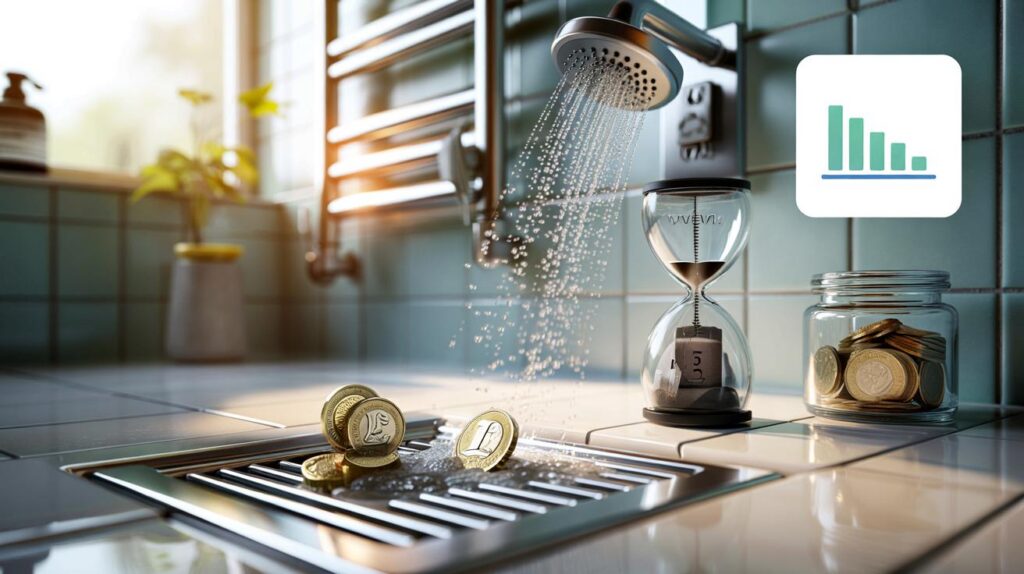
Time your routine. A five-minute playlist, a shower timer, or a waterproof sand timer sets the pace without stress. Families can turn it into a challenge. The goal is simple: same refresh, half the time, far less hot water.
Flow-savvy showerheads
Swap to an efficient showerhead rated 6 to 8 litres per minute. Air-mix models maintain pressure and comfort while halving flow. Combine this with the five-minute rule and your hot water demand can fall by 50% to 60% overnight.
A £20 efficient showerhead can pay for itself in six to twelve weeks, then keep cutting costs for years.
Check compatibility: power showers and some combi systems need specific low-flow models. Fit in minutes with plumbers’ tape to prevent leaks.
Dial down, not down and out
Temperature settings matter. If you have a combi boiler, set domestic hot water to 50–55°C to reduce scald risk and energy use. If you store hot water in a cylinder, keep the cylinder at 60°C to control legionella risk and mix down at the tap with a thermostatic valve. Small tweaks make a measurable dent in running costs.
Maintenance that stops invisible waste
Limescale acts like a fur coat on heating elements. Descale showerheads every three months and service cylinders or electric heaters yearly to keep efficiency high. Fix drips; one drip per second wastes about 12 litres a day, or more than 4,000 litres a year. Insulate hot water pipes near the cylinder to cut standing losses.
Fewer bottles, fewer drains
Bathrooms churn out plastic and liquid products that you over-pour. Solids, refills and durable accessories curb waste and spend while keeping routines simple.
Solid, refill or homemade
Solid soap and shampoo typically last two to three times longer than liquids. A refill station slashes packaging, and family-size bottles reduce cost per wash. For an occasional scrub, mix sugar with a little oil at home rather than buying a dedicated pot you barely finish.
Waste-light habits
- Keep one bottle of each staple open and finish it before starting another.
- Use washable makeup pads and cloths; launder with towels on a full load.
- Rotate two towels per person and wash weekly to cut laundry cycles.
- Store bars on a draining dish so they dry between uses and last longer.
What could you save in a typical flat?
Assumptions: one person, daily shower, electricity at 28p/kWh, gas at 7p/kWh, water and sewerage at £4/m³. Savings scale with household size and habits.
| Measure | Upfront cost | Annual saving (electric water) | Annual saving (gas water) |
|---|---|---|---|
| Cut shower from 10 to 5 minutes | £0 | ~£200 energy + £58 water | ~£50 energy + £58 water |
| Fit 7 l/min showerhead | £15–£30 | £60–£120 | £15–£35 |
| Lower DHW to 50–55°C (combi only) | £0 | £20–£40 | £8–£15 |
| Use towel rail timer (30 mins/day) | £8–£15 | £100–£150 | n/a |
| Fix dripping tap and descale | £5–£30 | £10–£30 + £10 water | £3–£10 + £10 water |
Even alone, you can slice £180–£320 a year; a household of three can see £400–£650, mostly from hot water.
Practical extras that widen the gains
Set up gentle prompts
Place a five-minute timer by the shower. Name your “get out” song. Stick a reminder on the rail: “Off after warm.” Small cues steer habits without effort.
Renters and students
Choose upgrades you can take with you: showerhead, timers, draft-excluding door snake for warm air, and pipe foam sleeves. Keep old parts to swap back when you move.
Smart meters and real-time feedback
Watch the in-home display before and after your shower. Seeing the spike drop after a week motivates change. Many water companies also offer free leak alarms; ask for one if you have a meter.
Health and comfort checks
If your cylinder stores water, keep it at 60°C to manage legionella risk and use mixing valves at outlets for safe delivery. Child-friendly taps with thermostatic mixers give comfort at lower flow. If your skin dries out, a shorter, warm shower and a pea-sized moisturiser will often help more than a longer, hotter soak.
Run a quick personal audit this week. Count showers, measure flow by timing how long it takes to fill a one-litre jug, and note appliance run-times. With those figures, you can simulate your own savings: multiply litres saved per shower by 0.035 kWh to estimate energy saved, then apply your tariff and water charge. That fifteen-minute exercise turns guesswork into a plan that trims pounds without trimming comfort.



Brilliant breakdown—finally a guide that actually quantifies the bathroom’s hidden costs. The five-minute rule plus a 55°C DHW setting feels doable, and the flow‑savvy showerhead tip is gold. Thanks for the clear maths and renter‑friendly hacks!