
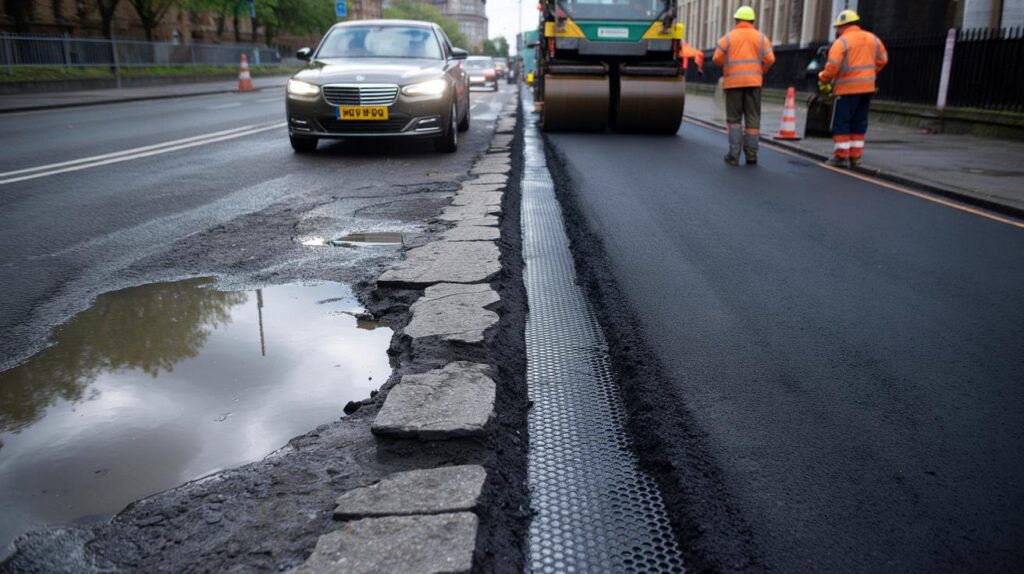
Tyres thump, suspensions groan, and budgets creak as Britain’s worn roads test drivers, councils and patience in equal measure.
Across the country, crews patch craters as fast as budgets allow while engineers chase materials that can outlast British weather. One candidate, strengthened with graphene, now has three years of real‑world data behind it and a growing list of backers willing to put it down on busy tarmac.
What sits behind the promise
Most local roads use asphalt: crushed stone bound by bitumen. It lays quickly, grips well, and degrades under traffic, heat, rain and frost. Microcracks let in water. Freeze–thaw cycles prise the surface apart. Heavy axles press ruts into the top layer. At some point, the surface loses stiffness, water weakens the bond, and a small defect becomes a pothole.
Graphene changes the bitumen’s behaviour. The ultra‑thin carbon lattice disperses loads, stiffens the binder at high temperatures, and resists cracking when cold. Mix it into hot rolled asphalt (HRA) and, in theory, the surface rides out stress for longer before damage starts.
Lab tests on a live UK road section reported 10% higher stiffness and 20% better resistance to water damage in graphene‑reinforced HRA.
A1016 case study: side‑by‑side on real traffic
Where and how the trial ran
In 2022, Essex Highways laid two surfaces shoulder‑to‑shoulder on the A1016 in Chelmsford: standard HRA and the same mix enhanced with a graphene additive. After three winters and summers, engineers drilled core samples and handed them to an accredited lab for independent testing.
The programme applied two checks. First, how much force a dry core needed before its structure distorted. Second, how much force a water‑soaked core needed before cracking. The graphene section scored higher in both, with the failure mode shifting from the binder to the aggregate itself. In practice, that suggests the bond between stone and bitumen held together better under stress and moisture.
What it cost to try
The upgrade added £2.50 per square metre over standard HRA. On a town‑centre resurfacing job of 8,000 m², that uplift comes in at £20,000 before traffic management and labour. The bill lands upfront, while the payback arrives later through fewer defects, fewer closures and a longer interval before the next resurfacing.
Upfront uplift: £2.50 per m². Potential dividend: fewer repairs, longer life, lower rolling resistance on smoother roads.
Who is watching, and why budgets matter
Essex maintains roughly 5,000 miles of roads. Residents complain about potholes more than almost anything else in local services. Since early 2024 the council has pushed an extra £47.5m into highways, but demand still outpaces cash. Across England and Wales, crews fill one pothhole about every 18 seconds. The industry estimates a £17bn shortfall to bring local roads up to a steady, good standard.
Against that backdrop, a pricier surface faces a simple question: will it last long enough to pay for itself? National Highways has now put a kilometre of the graphene mix onto the A12 between Hatfield Peverel and Witham to answer that on a strategic route. On local networks, each council must choose when a higher spec is worth it and where a cheaper fix will do.
How the options stack up
| Material | Typical uplift vs HRA | Stiffness change | Water sensitivity | Current use |
|---|---|---|---|---|
| Hot rolled asphalt (HRA) | Baseline | Baseline | Baseline | Urban carriageways, heavy wear lanes |
| Stone mastic asphalt (SMA) | Similar | Good rut resistance | Open texture can hold water | Many A‑roads, faster routes |
| Graphene‑reinforced HRA | +£2.50 per m² | Approx. +10% in testing | Approx. +20% in testing | Trials on urban and trunk sections |
What matters on the ground
Right road, right recipe
No single surfacing suits every street. High‑stress junctions benefit from stiffer mixes. Quiet estate roads need lower costs and quick laying. Cycle‑heavy corridors might favour slightly rougher textures for grip. Engineers will match the graphene blend to locations where rutting and water damage bite hardest.
Quality of laying and drainage
Even the best mix fails early if drainage is poor or compaction falls short. Good falls to gullies, sealed joints at ironworks, and properly compacted layers extend life more than any additive on their own. The trials sit alongside work on better laying methods, not in place of them.
Testing, transparency and trust
One of the contractors also holds a directorship in the lab that ran the tests. The facility operates under UK accreditation rules designed to protect impartiality. That will not stop scrutiny, and more data from other sites, other labs and other climates will help settle nerves.
Why drivers may notice more than fewer cones
Rough roads increase rolling resistance. Smoother surfaces cut the micro‑drag that saps momentum. Studies suggest that can trim fuel use and tyre wear at the margins. For a delivery van pounding stop‑start routes, small percentage gains add up across a year. Noise drops too, which matters on urban streets where traffic hum seeps through bedroom windows.
- Fewer emergency call‑outs reduce lane closures and queue time.
- Better water resistance helps during intense downpours now common in UK summers.
- Longer resurfacing cycles free crews to target notorious hotspots.
- Smoother carriageways can lower crash risk linked to sudden swerves around holes.
What councils will weigh next
Expect a cautious rollout. Highways teams will select short sections with heavy braking, bus routes, and junction approaches to gather comparable data. They will measure defect counts, rut depth, skid resistance and noise at the kerbline, then run life‑cycle costings against traffic models. If the curves hold for another winter or two, take‑up will widen.
Councils face a simple equation: pay £2.50 more today, or gamble on paying for crews, cones and claims tomorrow.
Useful context for readers
Graphene is not the only upgrade under trial. Polymer‑modified binders, crumb rubber from tyres, steel slag aggregates and fibre reinforcement are all gaining ground. Each tackles a different failure mode. Local authorities will likely blend several ideas: better drainage and ironwork detailing, targeted reinforcement on wheel paths, and smart inspection using cameras and machine learning to spot early cracks before they bloom into holes.
If you live on a street with recurring potholes, logging repeat defects with dates and photos helps engineers build a case for resurfacing rather than patching. If you run a fleet, record suspension and tyre costs by route; smoother, durable surfaces on core runs can justify targeted investment through reduced wear, even where fuel savings are modest. And if you cycle, report standing water after rain; persistent puddles mark drainage issues that shorten any surface’s life, graphene or not.



One of the contractors also sits on the lab’s board—how are conflicts managed in practice? UKAS accreditation is great, but can we see raw data and an independant replication on a different site and climate?
If £2.50 per m² saves cones, queues, and cracked alloys, sign me up 🙂 Smoother roads mean lower rolling resistance and less cabin noise—my kids might finally nap 😉