
Colder days push pets indoors and routines change. Many owners notice meals vanish in a blink, with mess and worry to follow.
Your cat is not just greedy. Speed-eating often stems from instinct, stress or competition at home. A simple change to how food is served can slow the pace, calm behaviour and protect digestion without making mealtimes a battle.
Why cats bolt their food
Cats descend from solitary hunters. That heritage nudges many to eat fast before a rival arrives. In multi-cat homes, silent competition at the bowl can trigger racing and guarding. Even a dog hovering nearby can push the pace.
Stress adds fuel. House moves, new people, a closed door to a favourite room, or a shift to winter hours may raise anxiety. Bored cats also self-soothe with food. Some who once faced scarcity keep a “now or never” pattern for years.
Fast eating is not harmless. It increases regurgitation, bloating and wind. It blunts satiety signals, so the cat begs for second helpings and gains weight. Sudden changes in appetite can signal illness as well. Speak to your vet if the speed is new, if weight shifts sharply, or if diarrhoea and lethargy appear.
Aim for meals that last 10–15 minutes. Pace, not portions, is the lever that protects digestion.
The simple slow-feed fix
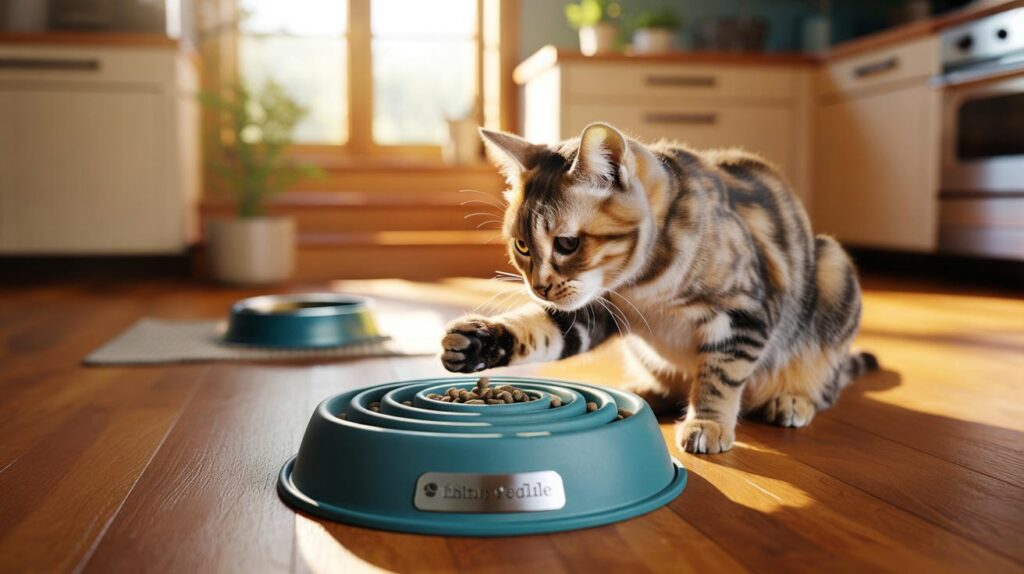
Slow-feed bowls use ridges, spirals or nubs that make the cat fish out small mouthfuls. The design forces licking and pawing, not gulping. Entry-level models start at about £9. Sturdy versions in stainless steel or heavy resin sit around £15–£25.
Many owners report a steep drop in post-meal sick episodes once the rush ends. Extending a one-minute meal to ten minutes often brings calmer behaviour, fewer puddles on the carpet and better stools. Cats engage their brains and their whiskers, which adds natural enrichment.
Switching from a flat bowl to a slow feeder often cuts regurgitation incidents by roughly a third in everyday cases.
Visible benefits for you and your cat
Calmer approaches to the kitchen. Less yowling before meals. Measured chewing. Longer gaps between snacks because satiety has time to build. You spend less on cleaning products and fewer evenings scrubbing the rug.
Turn feeding into a mini hunt
Feeding can do more than fill bellies. Mimic a hunt with small challenges that stretch the meal, stimulate the senses and reduce frustration. Rotate simple ideas to keep interest high.
- Scatter a portion of dry food across a wipeable mat or tray to spread bites out.
- Hide small piles in three rooms so the cat searches, eats, then rests.
- Offer a puzzle ball for 5 minutes before the main bowl to take the edge off.
- Move bowls away from glass doors or busy walkways to lower vigilance.
- In multi-cat homes, feed each cat out of sight of the others.
Keep the challenge fair. Do not cut calories to slow the cat. Reduce speed by design, not by hunger.
Pitfalls to avoid
Skip sharp or flimsy plastics that can nick tongues or trap claws. Start easy, then increase complexity in steps. If frustration builds, simplify the pattern or raise bowl height slightly. Wash puzzle feeders daily; stale oils stick and smell, and that can put fussy cats off.
Wet food can join the plan. Spread a portion thinly on a lick mat or a shallow plate with ridges. Mix textures across the day: one wet session on a mat, one dry session in a spiral bowl. A few teaspoons of warm water mixed into wet food boosts hydration and slows the pace further.
Practical numbers: portions, timings and gear
Feeding plans work best with numbers. Energy needs vary by age, neuter status and activity. As a rough guide, start here and adjust with your vet’s advice and weekly weight checks.
| Cat weight (kg) | Daily energy (kcal) | Typical dry food (g/day) | Target meal time | Meals/day |
|---|---|---|---|---|
| 3 | 150–180 | 40–50 (at ~370 kcal/100 g) | 10–15 minutes | 3–4 |
| 4 | 180–220 | 50–60 | 10–15 minutes | 3–4 |
| 5 | 220–260 | 60–75 | 12–18 minutes | 3–4 |
Check the calorie label on your bag. Brands vary from about 330 to 420 kcal per 100 g. Weigh food with a digital scale rather than a scoop for accuracy. If weight creeps up while meals run longer, trim total daily grams by 5% and recheck in two weeks.
Multi-cat strategies that tame competition
Competition often fuels bolting. Offer one feeding station per cat, plus one spare. Space them out. Feed shy cats on a raised surface or behind a baby gate. If one cat steals, a microchip-activated feeder can lock out the thief. Place water in a different spot from food to cut crowding at the bowl.
When to call the vet
Fast eating that persists despite slow-feed tools can mask medical problems. Ring your vet if you see blood or coffee-ground material in vomit, repeated retching without results, choking, swollen abdomen, rapid weight loss, ravenous appetite with weight loss, or new thirst and weeing. Conditions such as dental pain, parasites, hyperthyroidism or diabetes can change eating patterns and speed.
Budget and DIY options that work today
You do not need fancy kit to start. A muffin tin makes multiple tiny wells. An egg carton spreads bites. A shallow baking tray filled with clean, smooth pebbles creates channels. A cardboard tube taped to a stable base turns into a simple rattle feeder. Supervise at first to make sure chewing does not shift to the props.
A two-week plan you can follow
Day 1–3: Switch to a simple ridge bowl. Keep portions the same. Feed in a quiet corner. Time the meal. Target two minutes longer than your current baseline.
Day 4–7: Add a puzzle ball for five minutes before the bowl. Move the bowl to a new spot each day. Stretch meal time toward eight minutes.
Day 8–14: Introduce a lick mat for one wet-food meal. Scatter 10% of the dry ration on a tray. Aim for 10–15 minutes total feeding time without signs of frustration.
Signs the plan is working
Fewer post-meal sick patches. More regular stools. Longer naps after meals. Less begging. A steady body weight within your target range.
Extra gains beyond the stomach
Controlled pace trims calorie spikes, which can smooth energy levels and mood. Small “hunt” tasks sharpen focus and drain nervous tension. For indoor cats, this doubles as mental exercise. Add a three-minute feather play before each meal to mimic chase, catch and eat. That sequence satisfies a deep behavioural loop and reduces night-time zoomies.
There are small risks to manage. Overly complex feeders can cause frustration and food refusal. Oversized kibble may jam in narrow channels. Start under supervision, adjust the pattern and choose sturdy, food-safe materials. The upside is strong: better digestion, safer weight, calmer homes and cleaner carpets, all from a low-cost change that respects feline instincts.



Tried a spiral bowl last month and it turned my vacuum kitty into a polite chewer. Fewer puke puddles and calmer evenings—who knew £9 could save my rug?