
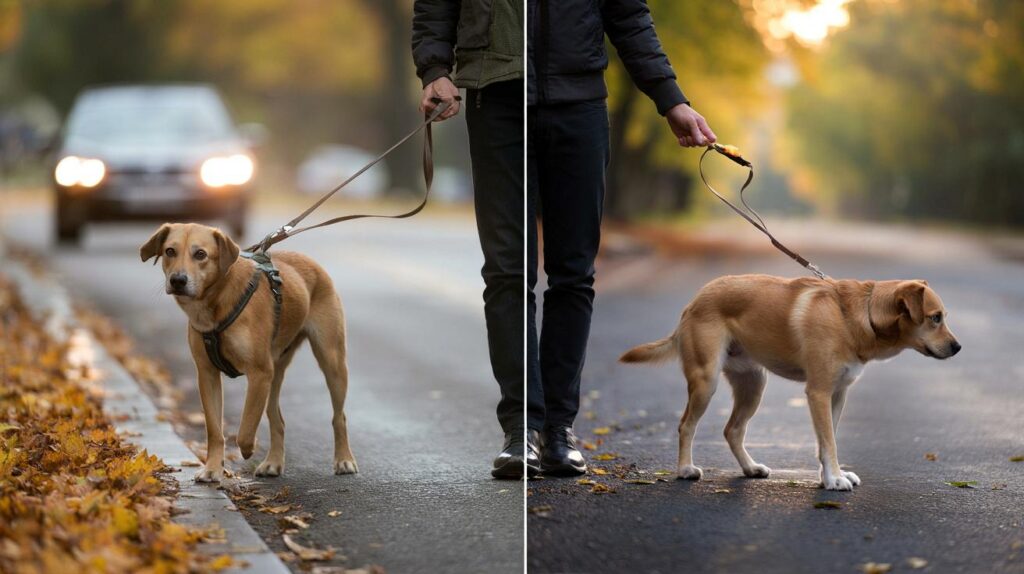
Golden leaves, wet kerbs, a taut lead, and a heart that races. Your next step alone decides whether calm returns.
Many owners see tension bloom before the first junction. Ears pin back. The nose scrapes the ground. One sharp tug or brisk command and the mood sours. Small acts ripple through the lead and turn a stroll into a struggle.
Small gestures that spark big stress
Dogs notice what hands, feet and voices do. A quick jerk, a fast breath, or a clipped tone can raise their guard. The lead transmits every micro-movement straight to the body. The dog reads it as a warning, not a guide. Repeated frictions build a pattern. The pattern becomes worry before the front gate.
Dogs absorb our state like a sponge. Calm hands and slow breaths lower the volume of the street.
Reading the early signs
Stress shows up early if you know where to look. The fixes work best when you act at the first hint.
- Slowing down or freezing at a doorway means uncertainty about what lies ahead.
- Sudden pulling back signals the urge to create space from a sound or sight.
- Head turning away, whale eye, or lip licking marks mild discomfort rising.
- Sniffing that looks frantic, not curious, often masks mounting pressure.
- A tight, high tail or stiff shoulders forecast a burst of barking or lunging.
Respond to the first sign, not the loud one. Intervene softly and early. Late corrections add fuel to a fire already lit.
The lead as a line of trust
A lead is more than a strap. It is a live channel between species. Your hand writes the walk’s tone into the lead. The dog reads every line. Smooth, steady handling breeds confidence. Erratic handling reads as threat.
Slow, soft, steady beats fast, firm, forceful. The lead should feel like a seatbelt, not a steering wheel.
A shared rhythm, not a drill
Control does not mean clamping down. It means setting a tempo both of you can keep. Aim for a gentle “J” in the lead most of the time. Reward the moments when it stays light. Guide rather than drag. Speak low and brief. Pause before pressure. Then show where to go with your body, not with force.
| Common habit | What the dog feels | Better swap |
|---|---|---|
| Snatching the lead when a car passes | Ambush, danger nearby, prepare to bolt or bark | Step aside early, loosen grip, feed calmly as the car rolls by |
| Repeating a harsh “no” at every sniff | Scents mean trouble, curiosity gets punished | Allow brief sniffs, say “let’s go” once, mark and treat the re-join |
| Stopping dead without warning | Startle, bump, confusion about the plan | Exhale, slow, then plant feet and signal with a hand target |
| Holding the lead tight by default | Constant pressure equals constant risk | Float the lead; shorten only near hazards, then soften again |
Turning tension into ease with positive reinforcement
Reward what you want, right when it happens. Mark light lead moments with a soft “yes”. Pay tiny, frequent rewards at first. Smell breaks count as pay. Food works well in busy streets. Praise matters in quieter spots. Many dogs settle when they earn four to six small rewards per minute at the start. The rate drops as habits stick.
Choose gear that supports comfort. A well-fitted Y-front harness protects the neck. A 2–3 metre lead creates room to think. A long line suits parks, not pavements. Test your setup at home before a busy route. The right kit removes friction you would otherwise try to fix with words.
Fix 1: the three-breath reset
When tension spikes, stop early and breathe out three times. Loosen your grip between each breath. Keep the lead low and still. Feed three tiny treats near your knee. Step off slowly on the third exhale. The dog pairs your breath with relief. The street quietens without a fight.
Fix 2: the five-metre sniff zone
Pick a patch of verge or leaves. Give five metres of casual sniff time. Count to twenty while you look around and relax your shoulders. Say “let’s go” once, then turn your body away. Mark and reward the first step with you. Curiosity resets nerves better than marching on.
Fix 3: the ten-treat loose-lead drill
Walk ten paces on a quiet stretch. Feed a pea-sized treat for each pace the lead stays slack. If it tightens, step back two paces, soften the lead, and try again. Many dogs switch from towing to tracking you within two or three rounds. Keep sessions short. Quit while you are ahead.
Change one detail and the whole walk shifts. A calmer hand today becomes a calmer dog tomorrow.
When autumn streets add pressure
October brings darker routes, damp scents, and more rustling leaves. Each adds novelty that can rattle sensitive dogs. Plan earlier walks where possible. Use a reflective lead and harness for visibility. Skip crowded cut-throughs on windy nights. Choose open pavements where you can arc around triggers with time to spare.
What to do when triggers stack up
Stress accumulates across the day. A rough delivery, a skipped nap, and then a busy walk can tip a dog over threshold. Shorten the route. Swap speed for scent work. Run a five-minute search for scattered kibble in grass before heading home. Rest reduces risk better than forcing the distance.
Practice at home to beat street chaos
- Rehearse hand targets in the hallway, then move to the drive.
- Teach a soft “find it” scatter cue to defuse tension fast.
- Drill slow turns around a cone or plant pot to build focus.
- Record a two-minute audio log of your breaths and steps to spot patterns.
Extra notes worth your time
Collars can place pressure on the trachea when dogs pull hard. A switch to a front-clip harness often cuts coughing and reduces reactivity by removing discomfort. Long lines help in fields but snag on street furniture. Choose surfaces with few obstacles if you use one, and never clip to a collar with a long line.
Some dogs carry tension from past frights. A gradual plan helps them most. Start with two calm, very short walks per day. Add one minute every two days. Keep the first week within your quietest block. Track progress in a notebook. Small, steady gains outlast a heroic push.
If progress stalls, review diet, sleep, and pain. Sore joints stiffen gaits and can make restraint feel worse. Gentle bodywork, vet checks, and softer routes support behaviour change. A relaxed body learns faster than a braced one. Your lead then becomes what it should be: a thin line of trust, not a tripwire.



Just tried the three-breath reset on our after-work loop and wow—my spaniel unclenched before we hit the main road. Pairing my exhale with three tiny treats felt almost too simple, but it worked. Feels kinder to both of us. Thanks for the calm, pratical tips! 🙂