
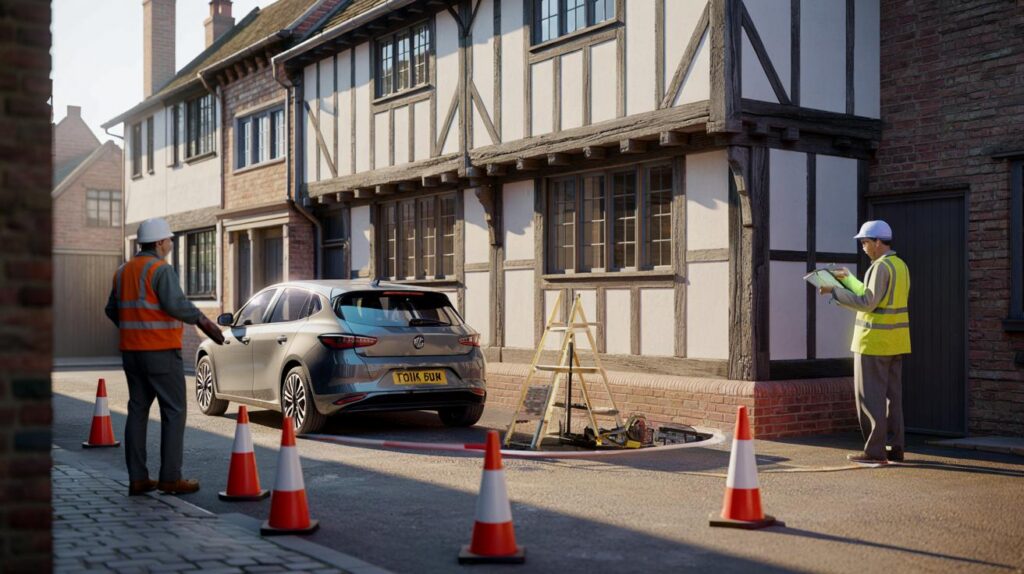
A quiet morning turned uneasy in Stratford-upon-Avon, where centuries-old timber met a modern mishap and locals drew a sharp breath.
The Shakespeare Birthplace Trust confirmed that a car reversed into Hall’s Croft on Friday morning, striking the timber-framed frontage of the Grade I-listed property. No one was hurt, staff made the area safe, and specialists began planning a close inspection as part of an ongoing conservation programme.
What happened on Friday morning
Witnesses reported a short, heavy jolt as a vehicle backed into the exterior of the 17th-century house. Trust staff quickly cordoned off the immediate area, checked the internal rooms for movement or cracking, and logged the incident for insurers and conservators. The driver cooperated and the collision was treated as an accident.
The trust reports 0 injuries, the site secured, and a specialist assessment of the affected timbers already in motion.
- Location: Stratford-upon-Avon, a short walk from the River Avon
- Building status: Grade I-listed, among the top 2–3% of protected buildings in England
- Era: principal timber-framed frontage dated to 1613
- Historic link: once home to Shakespeare’s daughter, Susanna, and her physician husband, John Hall
- Current work: significant conservation project already under way before the incident
Why this house matters
Hall’s Croft carries a rare level of protection because of both its fabric and its story. The house links directly to the family life that surrounded William Shakespeare, anchoring his legacy in a domestic space rather than a stage. For much of its life it sheltered professionals and prosperous townspeople; by the mid-1800s it even served as a small school, showing how buildings evolve as communities change.
After the Shakespeare Birthplace Trust purchased the property in 1949, it underwent substantial repairs and opened to the public in 1951. Since then, visitors have walked creaking floors, studied the timber joints, and stepped through rooms that hint at the routines of an early modern household. It is a place where architectural detail meets literary heritage.
| Year or period | What happened |
|---|---|
| 1613 | Main timbered frontage constructed |
| Mid-1800s | Building used as a small school |
| 1949 | Shakespeare Birthplace Trust purchased the property |
| 1951 | Opened to the public after repairs and alterations |
| 2020s | Major conservation project in progress; vehicle strike during works |
The conservation challenge
Repairing a timber-framed house from the early 1600s requires patience and precision. Conservators usually begin with a structural survey, moisture readings, and careful mapping of each joint. If the impact has deformed or crushed the outer posts, specialists will stabilise the frame with temporary shoring before they replace or splice damaged sections with seasoned oak. Lime-based mortars and breathable plasters will follow, allowing the historic fabric to manage moisture as intended.
Costs are rising, and lead times have lengthened as the pool of skilled craftspeople shrinks. Conservation carpenters, lime plasterers, and lead workers are in short supply across Britain. That means longer schedules and higher bills for heritage bodies, even for routine maintenance. A sudden impact, like a reversing car, adds unplanned work to an already tight programme.
Rising costs and a shortage of heritage trades mean every repair takes longer, and every impact bites deeper into budgets.
What happens next
Trust managers will now combine engineering advice with conservation best practice. Expect scaffolding, a full photographic record, and a measured survey to guide the joinery. The team will test adjacent timbers for hidden stress fractures and check the plinth for movement. Insurance and fundraising will cover the unexpected repair element, while planned works continue where safe.
- Stabilise: install props and lightweight shoring to relieve load on strained joints
- Survey: use laser measures and moisture probes to map affected zones
- Repair: splice or replace oak members, match lime materials, and reinstate finishes
- Protect: review kerbside barriers and delivery access to cut future risk
- Reopen: phase visitor access as zones pass safety checks
Vehicles and fragile streetscapes
Historic towns carry modern traffic on streets designed for carts, not cars. Tight corners, limited sightlines, and on-street parking raise the odds of low-speed collisions. Even gentle impacts can transfer surprising loads into a centuries-old frame, especially where timber meets brick infill near ground level.
Simple measures reduce the risk without turning heritage into a fortress. Discreet bollards, raised planters, speed cushions, and better signage all help drivers judge distances. Timed delivery windows and clearer markings near vulnerable frontages can ease pressure points on busy mornings. The aim is to keep places lived-in and welcoming while protecting the parts that cannot be replaced.
How you can help
Heritage trusts depend on a mix of ticket income, grants, donations, and local goodwill. People support them by giving, volunteering, or training in traditional crafts. Drivers who live or work near historic streets can slow down, reverse with a spotter where sightlines are tight, and avoid mounting kerbs near timber frames.
If you care about Shakespeare’s town, your choices on the road—and your support off it—make a measurable difference.
Context for readers
Grade I-listed status marks buildings of exceptional interest, the top tier of statutory protection in England. Only a small fraction of listed structures reach this level, and each carries obligations for careful maintenance. Consent rules do not block change; they shape it, so repairs respect original materials and proven techniques.
Timber-frame conservation relies on breathable systems. Dense modern products trap moisture and cause decay, so teams favour lime mortars, softwood sacrificial elements, and oak splices that move and breathe with the old frame. That approach costs more at the outset yet saves money by reducing hidden rot and repeat failures.
Practical takeaways for visitors and neighbours
- Look for temporary supports or barriers: they signal active conservation, not neglect.
- Report small cracks or fresh scuff marks if you spot them near doorways or posts.
- When reversing on narrow streets, use mirrors and sensors, but add a human guide if possible.
- Support training: bursaries for carpenters and plasterers help cut the skills gap.
This incident underlines a wider truth: heritage survives through steady care, good planning, and everyday caution. A single bump can undo months of work, yet a well-run repair can leave a building stronger and better understood. Hall’s Croft will tell that story too, from the first survey line to the last dab of limewash, as Stratford’s most famous family home steadies itself for the next century.



Heartbreaking to see a 1613 frontage take a hit. Please install discreet bollards and timed deliveries ASAP—no need to turn it into a fortress, just sensible risk reduction. Also, ensure lime repairs aren’t rushed; moisture mismanagment now would be a bigger disaster later.
Of all the places to practice reversing, they picked Shakespeare’s family doorstep—exit, pursued by a hatchback 😅 Glad it’s just timber and pride, not people. Curious if the driver’s insurer covers specialist oak splices or does that come under “act of bard”?