
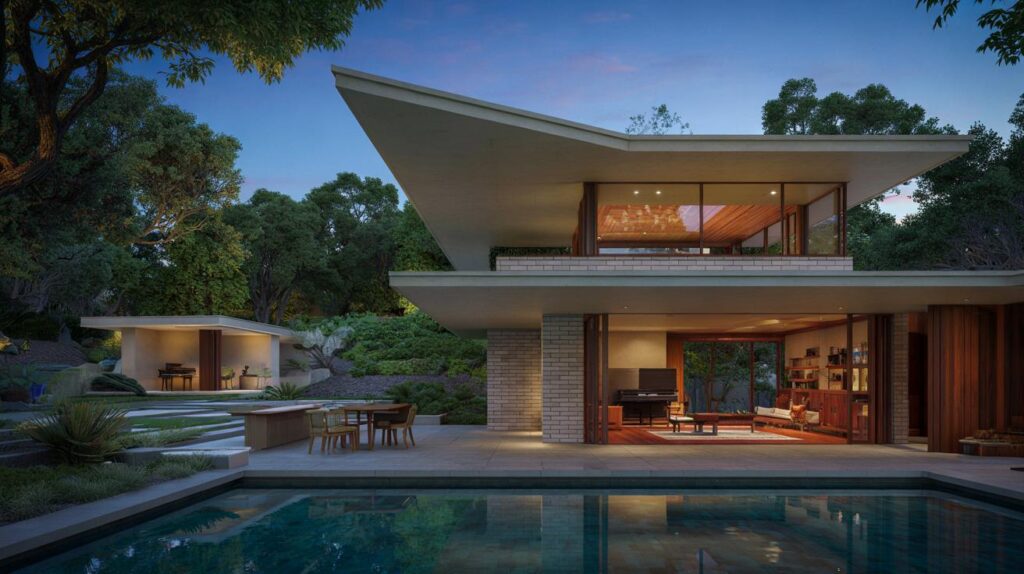
Timber glows, brick folds into geometry, and the roof angles like a folded card. You can almost hear music here.
The Lloyd Wright–designed Alfred Newman House has slipped quietly off the market, again. The numbers tell a revealing story, and the design tells the rest.
A house with a story
Built in 1948 by Lloyd Wright for Oscar-winning composer Alfred Newman, the 4,400-square-foot residence blends brick and concrete with striking warmth. The roof is steeply pitched, a notable break from the flat planes many expect from midcentury modern. Generous glass and built-in timber details keep the interior calm and tactile. The plot spans 1.4 acres, rare breathing space for a home with this pedigree.
Designed in 1948 for Alfred Newman, the five-bedroom home sits on 1.4 acres and spans 4,400 sq ft.
Keaton’s renovation choices
Diane Keaton bought the property in 2007 and led a top-to-bottom refresh. The kitchen was redesigned. Custom woodwork and built-in furnishings were restored rather than replaced, reflecting the younger Wright’s craft-forward approach inherited from his father. The primary bedroom, reimagined as a loft taking up the entire second floor, turned sleeping quarters into a serene perch above the living spaces.
What changed under Keaton
- Kitchen modernised with sympathetic materials and simple lines.
- Original woodwork and built-ins carefully restored rather than duplicated.
- Primary suite converted into a full-floor loft for light and privacy.
- Layered lighting added to emphasise texture and volume.
Design details that matter
Wright’s plan is both theatrical and practical. Public rooms gather around brick masonry and long sightlines. The steep roof shapes the interior volumes, creating a sense of shelter. Outside, the amenities speak to the commissioning client. There is an outdoor kitchen for long evenings and a pool tucked into the landscape. A detached music studio nods to Newman’s working life and still offers acoustic separation for recording or quiet work.
Outdoor kitchen, pool, and a detached music studio give the house both leisure and purpose.
How the price moved
Keaton listed the home in 2010 at $13.25 million after the restoration. Redfin data shows it eventually sold in 2020 for $9.25 million. The most recent owner put the 1.4-acre estate back on the market in February at $12.9 million. It returned twice with adjusted pricing and last appeared at $10.4 million with Frank Langen at Compass. The listing was removed on 30 September without a sale.
| Year/event | Price |
|---|---|
| 2010 listing after restoration | $13.25 million |
| 2020 sale | $9.25 million |
| February current-year listing | $12.9 million |
| Most recent asking price | $10.4 million |
| Market status as of 30 September | Withdrawn, no sale recorded |
Listed at $12.9m in February, trimmed to $10.4m, then withdrawn on 30 September.
Why buyers care about provenance
Architect attribution changes everything. A Lloyd Wright signature brings a defined audience and a long shelf life for interest. Provenance from Newman, then Keaton, adds cultural weight. That attention can lift values, but it also sets a higher bar for stewardship. Buyers inherit a story as much as a structure.
Features that justify a premium
- Documented Lloyd Wright authorship and midcentury date.
- Restored original woodwork and built-ins rather than replicas.
- Large lot size for its setting: 1.4 acres.
- Purpose-built detached studio with obvious creative uses.
- Primary suite occupying an entire floor for privacy.
Keaton’s broader architectural track record
Keaton’s interest in historic design showed up well before 2007. In the 1990s she acquired and restored Lloyd Wright’s 1928 Samuel Novarro Residence in Los Feliz, a Mayan Revival statement known for dramatic forms. She worked with architect Josh Schweitzer during that project. The property later returned to market in 2018 just under $4.3 million. Her pattern is consistent: buy a noted work, respect its author’s intent, and refine the material palette.
Reading the market signal
Three reappearances on the MLS within a year, followed by withdrawal, suggest a pricing and timing problem rather than a flaw in the house. Buyers at this level often move slowly, and architecture-led homes can take longer to match with the right person. The recent $10.4 million ask implies the seller tested different lanes before hitting pause.
What you should weigh if it returns
- Holding costs: taxes, insurance, and specialist maintenance for custom wood and masonry.
- Liquidity: architect-designed homes can take time to sell even when priced well.
- Use case: the detached studio offers work value, not just lifestyle appeal.
- Original fabric: confirm the extent of preserved elements and any reversible changes.
A quick sense of the numbers for you
At an asking price of $10.4 million, a 20% deposit would sit at $2.08 million before fees. Closing costs and annual ownership expenses can be material on a property of this scale, especially with grounds to manage and specialist trades for timber and brick. Buyers weighing cash against financing might also factor in opportunity cost given longer marketing periods for architect-led listings.
How to assess a midcentury restoration
Original woodwork and built-ins are both assets and responsibilities. Look at grain continuity and joinery where repairs were made. Check for seasonal movement in doors and drawers. Masonry deserves attention as well. Mortar colour and texture should be consistent across repairs. The roof’s steep geometry makes water management a priority, so inspect gutters and flashing with care.
Due diligence checklist
- Request documentation of restoration work, materials, and contractors.
- Confirm any preservation restrictions or review boards affecting exterior changes.
- Evaluate acoustic isolation in the detached studio if you plan to use it for recording.
- Ask for utility data to understand heating and cooling loads under that steep roof.
- Plan for a timber specialist to assess finishes and maintenance scheduling.
Provenance, condition, and documentation make the difference between a showpiece and a burden.
If this house returns to market, expect scrutiny from design-aware buyers and a premium placed on authenticity. The right offer will likely come from someone who values the mix of artistry and practicality: five bedrooms for daily life, a studio for work, and a roofline that gives the place a pulse.



That roofline is everything—like a folded card turned cathedral. The timber glow feels almost musical; Wright Jr. really knew drama.
Stunning provenance, but the pricing history screams liquidity risk. Years on/off the MLS, specialist masonary and timber maintenance… do the carrying costs erase appreciation? Not for the faint-of-wallet.