
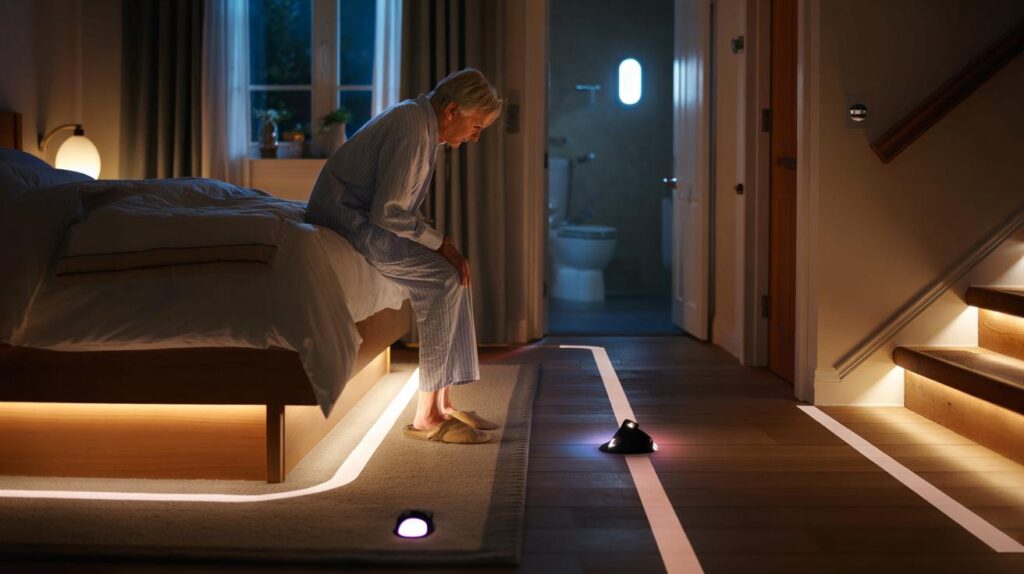
When lights think ahead, homes feel calmer. A quiet change in hallways is reshaping nights for families and carers.
Predictive, low-glare lighting is moving from gadget talk to everyday life, promising fewer slips after midnight and steadier steps at dawn. As households age and routines shift, small beams under beds and along skirting boards now act before you reach for a switch.
Why anticipatory lighting is surging
A third of people over 65 fall at least once each year, and darkness amplifies hesitation. Eyes adjust slowly after waking. Harsh ceiling light dazzles. A soft, guided glow narrows the gap between standing up and moving safely, especially on the route to the bathroom or kitchen.
Systems marketed as “anticipatory” do a simple job well: sense intent, raise light just enough, and point it in the right direction. The aim is to prevent the pause that leads to a misstep. Families value that it works every time without a phone, a code, or a clumsy switch.
Set pathways at 10–30 lux and bring light in gently. You want direction, not glare, and no hunting for a switch.
How the tech works in a hallway
Most kits combine two passive infrared sensors with a strip or two bulbs. One sensor watches the bed edge or bedroom door. The other watches the landing or the bathroom threshold. When the first sensor fires, a fade-in begins at ankle height, so shadows stay shallow and depth stays readable.
- Trigger range: typically 3–5 metres with a 120° field of view.
- Fade-in: 200–500 ms to reach 20–40% brightness, so pupils do not clamp down.
- Hold time: 30–120 seconds, adjustable per room.
- Standby glow: 1–5% as a locator, if desired.
- Power: battery sensors (6–12 months life) or mains for fixed strips.
- Mounting: adhesive pads under beds, on skirting, or on stair stringers.
Some kits use a small hub to coordinate several zones, so a step from bedroom to hallway keeps the same level of light. Others work stand-alone, which suits flats and guest rooms.
Keep light low and local: under-bed strips, stair nosing LEDs, and wall washers beat overhead glare at 2 a.m.
Confidence for older adults and families
Consistent light paths protect routines. People get up, visit the bathroom, and return to bed without calling for help. That preserves privacy and cuts anxiety. Carers sleep better when the house guides movement without noise.
For those with reduced vision or joint pain, even spacing matters. A line of low LEDs along the floor edge reveals changes in level. That tiny cue reduces shuffling, which often causes trips. Combined with secure handholds, it builds confidence to move at a normal pace.
Pairing light with stairlifts and other aids
Lighting does more when it supports mobility gear. A clear route to a stairlift seat lowers the chance of a slip before sitting. Gentle illumination on each tread helps users who still climb part of the day. Brands that fit stairlifts often add sensor lighting to keep the transfer calm and predictable.
A safer stair routine in three steps
- Place a sensor at the landing entry aimed across the top step, not down the flight.
- Add tread-edge LEDs or a wall wash at 10–20 lux to reveal depth and nosing lines.
- Use a delayed fade-out (60–90 seconds) so light remains while buckling a belt or turning.
Costs, kits and settings
Households do not need a full refit. Many start with one path from bed to bathroom. Prices vary with coverage and control. Running costs stay low because LEDs sip power and sensors only light what you use.
| Option | Typical upfront | Time to fit | Running cost/year |
|---|---|---|---|
| Plug-in nightlight (dusk sensor) | £8–£15 | 5 minutes | £1–£2 |
| Motion strip kit (2 sensors, 1 strip) | £29–£79 | 20–40 minutes | £2–£4 |
| Multi-room hub with scenes | £129–£199 | 1–2 hours | £4–£8 |
| Stair tread LEDs (retrofitted) | £90–£140 | 1–2 hours | £3–£6 |
Good practice keeps brightness modest. Aim for 10–30 lux along the floor and 50–100 lux at the sink. Reserve high output for tasks, not corridors at night. Warm white (2700–3000K) helps with sleep after you return to bed.
Choose warm light and short paths. Bright blue-white light wakes the brain and can steal the rest of the night.
Installation and privacy
Most people fit adhesive strips under bed frames or along skirting in less than an hour. Test the angle with tape before fixing the mount. Keep sensors 80–120 cm off the floor to catch hips and torsos, not pets. Avoid pointing directly at curtains or radiators, which can cause false triggers.
Many families reject cameras for private spaces. Sensor kits solve this by using infrared motion and ambient light levels only. No audio, no video, no cloud uploads. For those who want status checks, some hubs send a simple “movement at night” alert without streaming a feed.
What to tune this weekend
- Map the path from bed to bathroom. Count steps. Mark blind corners with painter’s tape.
- Set a 300–500 ms fade-in. Test barefoot at 2 a.m. to judge glare and shadows.
- Reduce hold time in the kitchen to 30 seconds to save energy. Keep 60–90 seconds on stairs.
- Check batteries on the first of the month. Keep spares in a labelled tub near the kettle.
- Pair lighting with grip points: a rail at the bed edge and a rail at the bathroom door.
Common snags and easy fixes
Pets can trigger lights. Narrow the sensor field or lower sensitivity. If lights wake a partner, reduce standby glow and confine the beam to the floor. Glare off polished tiles can confuse depth; add a matte rug with a contrasting edge.
People with cataracts or glaucoma may need brighter paths. Raise corridor light to 30–50 lux and use strong tread contrast. For those who use mobility frames at night, widen the lit zone to include both sides of the frame tips.
Where specialist support adds value
Companies that fit stairlifts and home mobility gear now bundle lighting plans. A technician can route power to the right side of a landing, tie lighting to a lift’s park position, and make sure no trailing cables cross a walkway. Families get a single contact for service and a clear schedule for maintenance checks.
Extra context that helps decisions
Lux is the key term to understand. It measures the light that reaches a surface. Hallways at night feel comfortable around 10–30 lux, while kitchens for tasks need closer to 150–300 lux. Use a phone light meter as a guide. It will not be lab-grade, but it will get you close enough to set dim levels sensibly.
A quick simulation clarifies placement. Sit on the bed in the dark. Stand and pause for two seconds. Walk the path at your usual pace while someone else notes where your feet hesitate. Those are the places to add a sensor or extend a strip. Small tweaks in those spots often remove the last unsafe step.



We installed a £35 motion strip in my dad’s hallway last month and the differrence is huge. The gentle fade-in beats the blinding ceiling light. Curious if anyone found the sweet spot closer to 15 lux or 30?
Sounds great on paper, but what about false triggers from pets? My cat treats PIRs like a game. Any real-world fix beyond narrowing the field—masks, height tweaks, or just moving the sensor?