
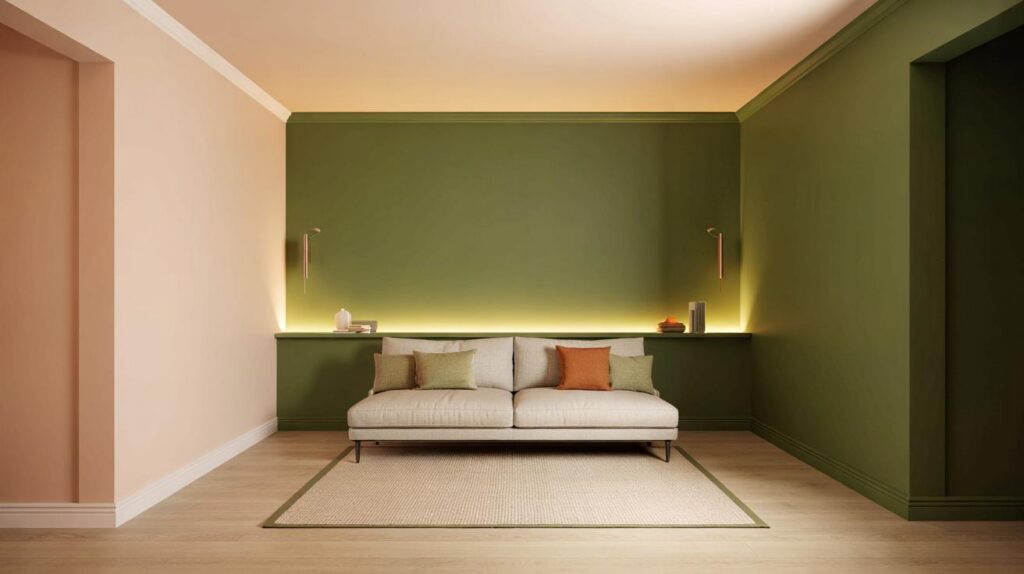
Winter squeezes small lounges. Light fades, furniture piles up, and corners feel tight. People want warmth without tearing down walls.
Designers across the UK are rallying around one neat move for 2025: turn a single wall into a bold focal point. A single accent colour or statement pattern reshapes how the eye reads the room, stretching width, depth and height without dust, builders or drama.
Why one wall changes everything
Our eyes hunt for contrast. Give them one strong surface and the rest of the space relaxes. The brain reads the highlighted plane as a boundary beyond the room’s true limits, so the lounge feels bigger and better balanced.
One well-chosen accent wall can make a compact lounge feel 15–35% larger by redirecting attention and clarifying sightlines.
Keep the surrounding envelope quiet. Light, low-contrast walls, ceilings and floors bounce daylight back into the room and sharpen the feature wall’s edge. The trick works in terraces, flats and lofts because it is about perception, not square metres.
Where to place your accent wall
Pick the broadest, cleanest wall you see on entry. Avoid walls riddled with doors, radiators or windows. The objective is a stable backdrop that anchors the layout.
- Behind the sofa: elongates the seating zone and tidies visual noise from cushions and throws.
- Facing the entrance: pulls you forward and pushes the rear boundary outward.
- End wall in a long room: reduces the “bowling alley” effect and adds balance.
- Chimney breast only if the alcoves stay light, or vice versa, to avoid a heavy centre block.
Measure before you paint. On a wall under 2.5 m wide, colour can feel cramped. Aim for 3 m or more of uninterrupted span so the effect breathes. In low-ceiling rooms, keep the colour to full height; a half-height band can visually compress the space.
Colours and patterns that work in 2025
Mid-to-deep, muted tones have momentum this year because they add depth without gloom. Think slate blue, forest green, tobacco, or a lifted terracotta. If you love darker shades, balance them with pale adjacent walls—warm whites, chalky greys or stone neutrals.
Check light reflectance value (LRV): aim for 10–30 on the accent wall and 65–85 on the other walls for crisp, room-expanding contrast.
Patterns can do the heavy lifting. Vertical motifs suggest height; fine horizontal lines broaden the room; soft geometrics add rhythm without fidget. Keep scale proportionate—one large repeat per 1–1.5 m is a good starting point in small lounges.
Light is your quiet accomplice
Light the feature wall and the room stretches towards it. Use warm white (around 2700–3000 K) for winter comfort and gentle contrast.
- Wall washers or adjustable sconces grazing the accent surface create gentle shadows that add depth.
- LED strips tucked on shelves or coves lift the perimeter and remove dark corners.
- Aim for roughly 2,000–2,500 lumens per 10 m² across three circuits: ambient, task and accent.
A dimmer on the accent circuit lets you dial the effect from lively to calm. Keep ceiling fixtures soft and indirect to avoid flattening the wall’s texture.
Furniture and styling: edit, then echo
Clear 30–40 cm of air in front of the feature wall. Low-slung, slim-legged pieces extend the floor plane and lighten the silhouette. Heavy units, tall bookcases and busy galleries fight the focal point.
Repeat the accent shade sparingly—two or three small echoes are enough to knit the scheme together.
- One cushion and a throw with a tonal match, not a perfect one.
- A single ceramic or lampshade picking up the colour by 10–20% in a lighter tint.
- A rug border or stripe that nods to the wall without stealing attention.
Cost, time and finishes
The appeal is speed and control. A weekend, a roller, and a calm plan. Here’s a realistic snapshot for a typical 3.2 m × 2.6 m wall:
| Item | Quantity | Typical cost (UK) | Time | Notes |
|---|---|---|---|---|
| Mid-sheen or matt emulsion | 2.5 litres | £28–£55 | 2–3 hours | Eggshell or soft matt hides minor flaws; avoid high gloss on uneven plaster. |
| Primer/sealer (if needed) | 1 litre | £12–£20 | 1 hour | Use on fresh plaster or drastic colour changes. |
| Quality roller + brush | 1 set | £12–£25 | — | Smooth, low-lint sleeves reduce texture lines. |
| Masking tape & dust sheet | — | £8–£15 | — | Crisp edges amplify the effect. |
| Statement wallpaper (optional) | 2–3 rolls | £70–£180 | 3–4 hours | Choose breathable, paste-the-wall for easier removal. |
| LED strip or wall lights (optional) | 1–2 fittings | £20–£85 | 1 hour | Indirect light enhances depth. |
Many lounges land between £120 and £380, depending on finish, fittings and whether you already own tools.
Common missteps that shrink space
- Painting two or more feature walls—contrast stops reading as a focal point and starts to box the room.
- Picking an ultra-dark shade in a north-facing lounge without compensating light.
- Overloading shelves or hanging busy galleries on the accent wall.
- Placing a tall cabinet directly against the feature—leave at least 10 cm gap or choose lower furniture.
- Chasing trends without testing samples at different times of day.
Room-by-room playbook
Victorian terrace, 12 m²: paint the chimney breast in a deep green-blue and keep alcoves light. Add a narrow picture ledge under the mantle with two warm LED spots to push light up.
Low ceiling, 2.3 m: choose a vertical grasscloth or fine pinstripe. Extend the wall colour 2–3 cm onto the ceiling as a soft “shadow line” to blur the junction and add perceived height.
Open-plan studio: zone the living end with an earthy terracotta wall behind the sofa. Repeat a diluted tint in the kitchen splashback or a single stool seat to thread spaces together.
Mansard loft: take the accent across the knee wall and 30–40 cm up the slope to simplify angles. Keep beams and trims pale to maintain a strong frame.
Test before you commit
Paint two A4 cards with two coats, one in your chosen colour and one a shade lighter. Move them around the room for 48 hours. Check under daylight, lamps and at night. If the colour blackens after dusk, step one notch lighter or warm the bulb temperature.
Inspect the wall with a raking light. Fill hairline cracks, sand lightly and prime patches. A smooth, uninterrupted surface strengthens the optical hit. Low-VOC paints improve air quality, especially in winter with closed windows.
Patterns that add space without fuss
- Soft chevron or herringbone: suggests movement and width.
- Large-scale botanicals with air between motifs: brings depth without clutter.
- Ombre or colour-wash: blends edges and diffuses boundaries.
Scale is king: one bold repeat per metre of wall keeps the eye calm while still delivering drama.
Extra gains you can stack without clutter
Try a tone-on-tone skirting in the same colour as the accent wall to lower visual contrast at floor level. Add a narrow shelf painted to match the wall and keep it near-empty—two objects, generous spacing. A rug with a 5–8 cm border in the wall colour tethers the seating island and feels deliberate.
If you rent, use peel-and-stick paper or paint returns of 10–15 cm on adjacent walls; the wrap effect still extends space. A single large mirror opposite the feature wall can double the depth, but aim it to reflect a calm surface, not a doorway or TV.
Risks, tweaks and when to rethink
High-contrast edges reveal wobbly plaster and poor taping. Spend 30 minutes on prep and score the tape before peeling. In very small rooms under 9 m², choose a mid-tone rather than near-black to avoid a tunnel effect. If daylight is scarce, add a table lamp that washes the wall; 400–600 lumens is enough to lift colour.
Families can future-proof the look by keeping the accent shade in a classic family (navy, green, tobacco) and switching soft furnishings with the seasons. If resale is on your mind, favour mineral hues and removable paper. The move is reversible in an afternoon, which keeps both costs and nerves steady.



Just tried a deep slate blue on the wall behind our sofa and wow—room legit feels wider. The tip about 2700–3000K warm lights was clutch; a small wall washer made the colour pop 🙂 Now debating a matching rug border—worth it or overkill?
35% bigger sounds… optimistic. Is there any actual data behind that or just eyeballs and vibez? Anyone got piccs?