
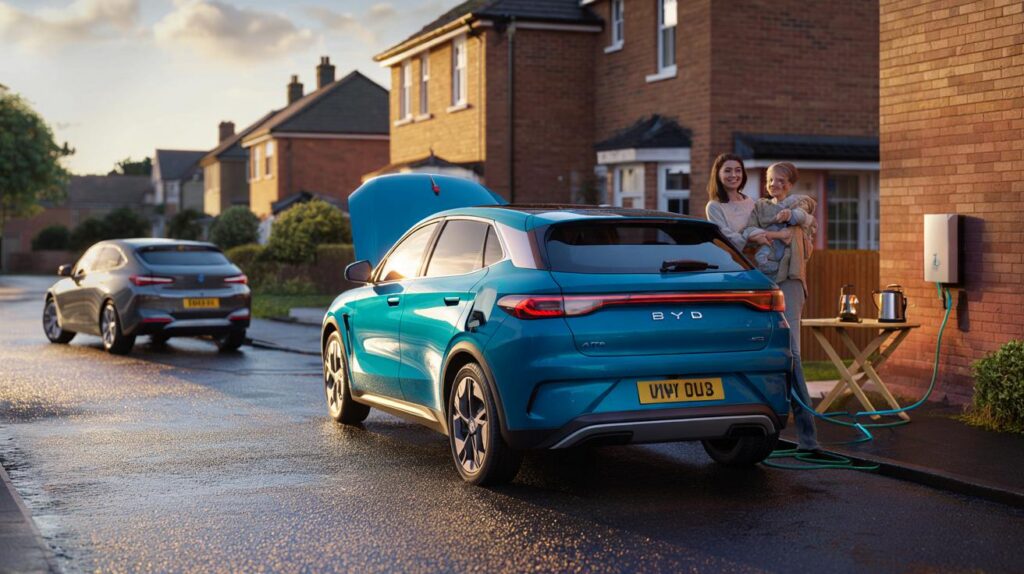
On British driveways, a new badge is quietly appearing, undercutting familiar Germans and tempting families with tech-heavy promise.
Two years after swapping a petrol hatchback for a Chinese-built EV, one Milton Keynes driver says he prefers it to German rivals. His experience mirrors a rapid shift in the UK market, where budget-friendly models from China are climbing sales charts and reshaping expectations about price, tech and ownership headaches.
A bargain that rattles the old guard
Chinese brands have gone from curiosity to mainstream contender in a single model cycle. BYD, Omoda and Jaecoo now feature in showrooms alongside the big European and American names. The attraction is blunt: more kit for less money, and batteries designed to charge to 100% without the gentle handling many EV owners have been told to adopt.
In September, 11,271 BYDs were registered in the UK — an 880% year‑on‑year jump — enough to outpace Land Rover, Mini and Tesla for the month.
That spike is not a blip. Supply is flowing, prices are aggressive and the brands have built dealer networks with national coverage. Western manufacturers face a price war they did not ask for and can’t easily avoid.
How the numbers stack up
- BYD UK registrations in September: 11,271 (+880% year on year).
- Vauxhall September registrations: 12,120; Skoda: 11,925; Volvo: 11,570.
- BYD Atto 2 start price: just under £31,000.
- Tesla Model Y current entry price: about £45,000.
- Previous data suggests Atto 3 retains around 49% after 36,000 miles.
- Polls show around seven in ten UK drivers would consider a Chinese brand.
Clever tech, familiar roads
Owners point to practicality rather than novelty. Vehicle‑to‑load capability lets the car power a campsite, tools or even top up another EV from its battery, using simple sockets. It’s handy during a power cut or for weekend hobbies that need watts more than words.
Battery chemistry is another selling point. BYD’s Lithium Iron Phosphate “Blade” cells prioritise stability and longevity. Many rivals advise routine 80% charging; Blade batteries are engineered to tolerate 100% charges more comfortably, reducing the daily faff of charge limits.
Cheaper to buy, simple to charge to the brim, and laden with kit — the pitch is less hype, more household arithmetic.
Charging, batteries and real‑world range
Range still shapes purchasing decisions. Tesla typically offers longer motorway legs than equivalent BYD models, and some drivers report extra service‑station stops on familiar routes. That said, new Chinese hybrids like Jaecoo and Chery’s systems claim 700‑mile figures, showing the gap is not fixed.
Range anxiety remains stubborn. A recent UK survey of non‑EV owners found 71% worry about running out mid‑journey. For most commuters, overnight home charging and the growing rapid network now cover the majority of miles. The edge case is long winter trips at motorway speeds, where efficiency drops and the quickest chargers can be busy.
The small print that bites
Not everything is cheaper. Servicing quotes for some Chinese models can exceed those for equivalent petrol or diesel cars. The early‑stage parts pipeline is still maturing, which can stretch repair times.
Servicing, parts and repair practices
Several owners report higher routine service costs than their previous cars. More pressing is parts availability. Where a component isn’t on the shelf, shipping can add weeks. BYD says it operates a UK parts warehouse supported by a major logistics partner, which improves availability on most items. Even so, global supply hiccups and new‑brand teething issues can slow things down.
Repair culture differs. In China, low labour costs can make panel replacement the default, even for light damage. In the UK, high labour rates mean large component swaps can render a repair uneconomic. British‑specific repair methods and parts catalogues are catching up, but they are not uniformly embedded across the network yet.
Insurance hurdles and how to clear them
Early adopters faced a patchy insurance market, with some underwriters unwilling to quote. That picture is improving as repair networks expand and data flows to insurers via organisations such as Thatcham Research. Several large insurers say they are still assessing risk while models bed in, which can mean higher premiums in the short term.
- Ask the dealer for written confirmation of approved UK repairers before you buy.
- Request Thatcham‑rated repair times and parts pricing to share with insurers.
- Shop around every renewal; prices have begun to ease for some owners.
Resale values and the pace of change
Depreciation bites hard in fast‑moving tech categories. Previous data indicates an Atto 3 can shed roughly half of its value in the first few years and 36,000 miles. Frequent over‑the‑air updates and robust batteries may slow that curve over time. For now, brand recognition still shapes second‑hand prices, favouring names with decades of cachet.
Price pressure helps at the showroom; weaker residuals can negate that benefit when you sell. Financing structure matters.
Leasing, subscription or PCP can offset volatility by fixing your exit. If you plan to keep the car for seven to ten years, strong battery durability and software support become more relevant than year‑one resale.
Data and geopolitics in the driveway
Security questions shadow many connected cars, not just Chinese ones. The US has restricted certain components, and UK public bodies have raised awareness about potential risks. Owners interviewed for this piece said they had no personal concerns and had not seen evidence of misuse.
- Review data‑sharing settings in the infotainment system at handover.
- Use driver profiles and PIN‑to‑drive where offered.
- Keep software up to date to patch vulnerabilities quickly.
What you should do before ordering one
Three checks that save money and stress
- Charging plan: confirm home tariff rates and test rapid‑charging compatibility near your regular routes.
- Insurance quote: get a firm quote using the exact trim and optional equipment; ask about approved repairers.
- Parts reality: request written confirmation of parts lead times for common items like lamps, bumpers and screens.
Cost calculator for a typical year
Run a quick estimate. Drive 9,000 miles at 3.7 miles per kWh and pay 29p per kWh at home. You’ll use about 2,432 kWh, costing roughly £705 a year. A 42‑mpg petrol driving the same distance at £1.45 per litre needs about 975 litres, near £1,414. That’s a saving of around £700 before servicing, insurance and parking perks. Public rapid charging at 59p–75p per kWh narrows the gap, so home or workplace charging remains the key lever.
Why people are switching to Chinese EVs
Household budgets decide most car purchases. A sub‑£31,000 family EV with heated seats, a big screen and bi‑directional charging is persuasive. Owners who compare test‑drive routes often find cabin quality and infotainment that matches or beats mainstream rivals. For many, the calculus is simple: buy now, save on fuel, accept some early‑market quirks.
The next 12 months
More ships, more spares and more local assembly should cut lead times. European‑based production partnerships are ramping up to meet rules‑of‑origin thresholds, which stabilises pricing. Insurers are digesting real claims data, which usually lowers premiums as repair paths become predictable. If Western brands respond with cheaper trims and simpler specifications, the biggest winner will be the UK buyer staring at their energy bill.
Expect a tug‑of‑war on range and charging speeds, and a fresh push on residual‑value guarantees. The question is no longer whether Chinese EVs belong on British roads, but how quickly the rest of the market adjusts to the price and tech benchmark they’ve set.



Interesting read. If BYD registrations beat Land Rover, Mini and Tesla for a month, does the depreciaton wipe out the upfront savings? 49% retained after 36k miles sounds rough. PCP/lease looks safer than owning outright—am I missing something?