
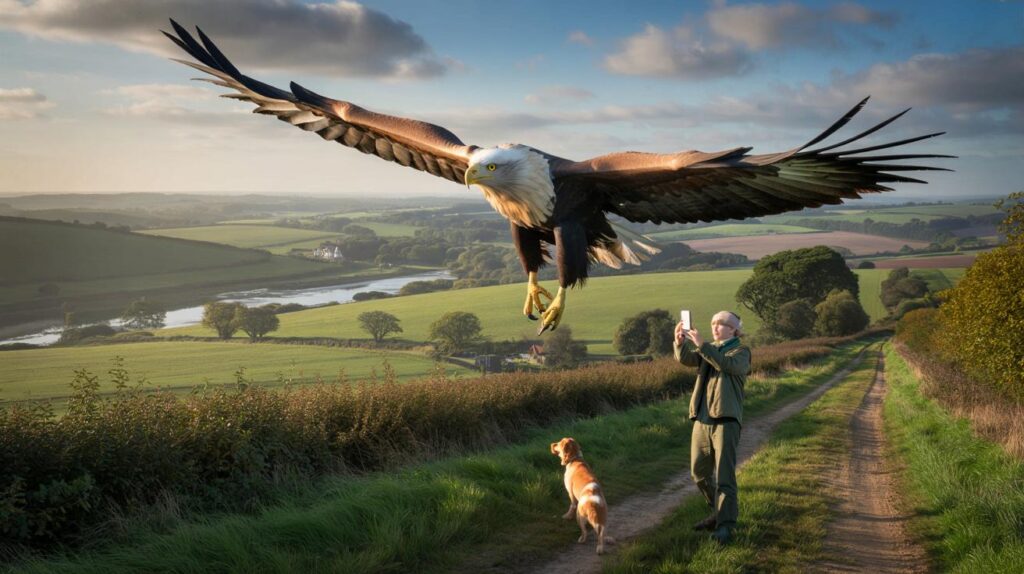
Look up from your dog walk this week and you might glimpse a giant silhouette that stops you in your tracks.
A vast white-tailed eagle shocked a farmer and several passers-by near Robertsbridge on Monday afternoon, stirring local chatter and phones. The bird appeared low over fields shortly after 4pm, casting an unmistakable shadow across the hedgerows. Its origin may trace back to the Isle of Wight reintroduction, which has slowly been putting these giants back into southern skies.
A rare visitor returns to southern skies
Farmer Will Hoad, who works land near Robertsbridge, watched the raptor sweep over pasture at around 4pm on 22 September. He believes the bird may have travelled from the Isle of Wight. That theory fits what biologists see during autumn, when young white-tailed eagles roam widely before settling.
The white-tailed eagle, also called the sea eagle, is Britain’s largest bird of prey. Adults span up to 2.5 metres from wingtip to wingtip. Their return to England is recent and carefully managed. The species vanished here in the late 18th century after decades of persecution, with the last English breeding recorded on the Isle of Wight in 1780.
In 2019, six young birds were released on the Isle of Wight at the start of a five-year programme run by Forestry England with the Roy Dennis Wildlife Foundation. The aim is straightforward: rebuild a vanished breeding population that can once again occupy coastlines and river systems in the south.
Britain’s biggest raptor is back in the south: up to 2.5m of wingspan, plank-like wings and a hulking silhouette.
A teatime sighting with a story
Witnesses around Robertsbridge reported a long, even wingbeat and a surprisingly broad frame. The bird circled, drifted downwind, then pushed on. The time of day matters. Late afternoon thermals often give large raptors the lift they need to wander along river valleys and ridges.
The distance from the Isle of Wight to East Sussex runs to roughly 80–100 miles. That is well within range for a strong, wind-assisted flight. Young eagles can cross counties in a day when the weather suits them. They often follow water, scanning for fish and waterbirds from height.
How to recognise a white-tailed eagle
- Huge, broad “plank” wings that look almost rectangular in level flight.
- Long, heavy body with a projecting head and thick neck.
- Large bill, pale on adults, that looks disproportionate at close range.
- Tail appears short on juveniles; adults show a bright white tail and paler head.
- Flight is steady and purposeful; less tilting and flicking than a red kite.
- Often near water but not tied to the coast; farmland sightings are increasingly normal.
Think “flying barn door”: a steady, slab-winged shape that dwarfs buzzards and kites in the same sky.
From extinction to a cautious comeback
The species was lost from England for more than two centuries. Conservationists chose the Isle of Wight for its cliffs, estuaries and proximity to the Solent and English Channel. Those habitats offer fish, wildfowl and carrion, which form a large share of an eagle’s diet.
Reintroduced birds carry discreet identifiers. Some also have satellite tags during their early years. Data show wide dispersal across southern counties, with occasional loops into East Anglia or the West Country. Most settle by their fifth year, pairing for life if a partner and territory suit them.
Diet, behaviour and breeding
White-tailed eagles hunt fish with sudden, low strikes, lifting prey clean from the surface with formidable talons. They will also take rabbits and hares. They scavenge dead deer and livestock carcasses, especially in winter. Waterbirds, including gulls and ducks, appear on their menu when the opportunity arises.
Pairs build massive nests on cliff ledges or in mature trees, often returning to the same structure year after year. Sticks accumulate, and nests can become huge platforms. The breeding season runs through spring into summer, with one to three chicks typical in a good year.
| Feature | White-tailed eagle |
|---|---|
| Wingspan | Up to 2.5m (8.2ft) |
| Weight | Roughly 4–6.5kg, females heavier than males |
| Main diet | Fish, waterbirds, rabbits and hares, carrion |
| Habitat | Coasts, estuaries, large lakes and wide river valleys |
| Lifespan | Decades in the wild when undisturbed |
Why this matters for East Sussex
Large birds at the top of the food chain signal healthier wetlands and rivers. They also bring people out with binoculars and camera lenses, which boosts local cafes and farm shops. Ecotourism linked to big raptors already delivers millions of pounds annually in parts of Scotland.
Concerns do arise. Free-range poultry and small lambs can be vulnerable in rare situations. Good husbandry reduces risk. Flocks that lamb indoors fare better. Carcass removal cuts scavenging near farmyards. Clear guidance helps communities keep both wildlife and livelihoods safe.
See one? Record the time, exact spot and what it was doing. A quick photo helps confirm the identification.
What to do if you spot one
- Keep at least 100 metres away; give the bird space to hunt or rest.
- Do not approach a nest site or a bird carrying sticks or prey.
- Note location, time, direction of travel and behaviour.
- Send your record to your county bird recorder or local wildlife group.
- Avoid baiting or calling; natural behaviour provides the best observations.
How it differs from other big raptors you see
Red kites look slimmer, show a deeply forked tail and flick their wings in gusts. Buzzards are compact, with rounded wings and a shorter, fan-shaped tail. Golden eagles are rare in England and favour uplands; their wings are narrower and more tapered, and they lack the white tail of adult sea eagles.
If the bird in your viewfinder dwarfs a nearby buzzard and glides on immense, ruler-straight wings, you are likely looking at a white-tailed eagle.
Where it might go next
Juveniles wander. A bird seen over Robertsbridge one afternoon could be over the Pevensey Levels, the Cuckmere, or Pagham Harbour within days. Estuaries, reservoirs and large gravel pits draw them in. Calm high-pressure days are prime times for long-distance flights.
As the reintroduction matures, occasional visits could turn into seasonal familiarity. If pairs find quiet trees or sea cliffs with easy access to food, nesting in southern England may resume more widely.
Extra context for curious readers
“Sea eagle” and “white-tailed eagle” refer to the same species. The name varies by country and by habit. In coastal districts, people often use the sea eagle label. Inland, the striking white tail of adults gives the species its everyday English name.
Risk to pets is often overstated. Healthy medium-sized dogs and adult cats are not typical targets. The birds prefer fish, waterbirds and carrion. Young lambs and weak animals can be at risk in open landscapes, which is why shepherds watch closely during lambing and use practical deterrents near fields that hold nesting or roosting birds.



Pretty sure I spotted it at 4:12 pm over Salehurst—huge, planky wings and a hulking silhouette that dwarfed a buzzard. Snapped a grainy pic; looks every bit a sea eagle. Anyone else see it sliding east along the Rother? 🙂