
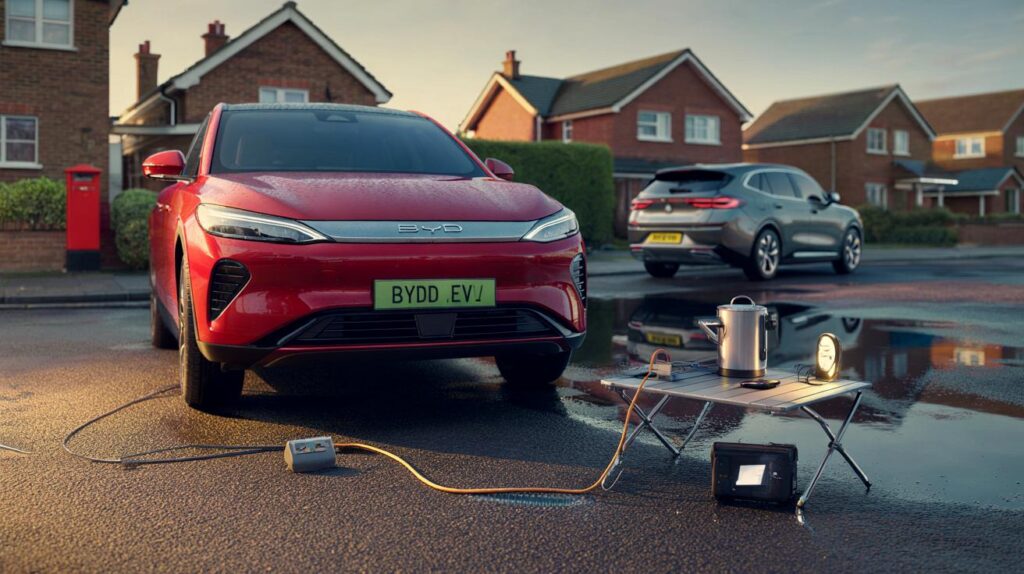
A family doctor traded a familiar hatchback for a budget EV. What happened next says plenty about Britain’s changing roads.
He expected to leave the dealership in a Tesla. He drove away in a Chinese-built BYD instead, paid thousands less, and hasn’t looked back. That choice now mirrors a national shift, with mainland brands climbing the sales charts, testing loyalties and rattling price lists across the forecourts of Britain.
Why one budget ev is causing a stir
Two years on from swapping a Honda Civic for a BYD, the owner says he prefers the way it fits his life to the German premium staples. He’s not alone. BYD says the UK has become its second-largest market after a sudden burst of demand this autumn. Motorists who once eyed a Tesla are test-driving alternatives that undercut the Silicon Valley star by five figures while still bundling headline tech.
UK buyers registered 11,271 BYD cars in September, an 880% leap on last year — more than Land Rover, Mini and Tesla that month.
On pavements from Peterborough to Milton Keynes, Atto-branded crossovers have started to outnumber the early EV pioneers. Neighbours talk about practical features rather than badge cachet. Powering a kettle at a campsite. Charging a friend’s car from their own. Running tools off the boot at a kids’ football match. Those are small, clever conveniences made possible by vehicle-to-load (V2L) sockets now common on Chinese models.
What’s driving the rush
- Vehicle-to-load: onboard sockets power appliances or even top up another EV, turning the car into a mobile battery.
- LFP “blade” batteries: lithium iron phosphate chemistry reduces reliance on nickel and cobalt and can tolerate regular 100% charges.
- Integrated supply chains: battery, electronics and assembly sit under the same corporate roof, cutting costs and time.
- Over-the-air updates: software features and fixes arrive remotely, extending the useful life of the car you already own.
Owners praise the ability to charge to full overnight without fretting about long-term degradation — a cultural shift for EV habits.
The price shock that moves the needle
Price remains the blunt instrument. The newest BYD Atto 2 sits just under £31,000. A Tesla Model Y starts near £45,000. In a cost-of-living squeeze, £14,000 is more than a rounding error; it’s a family holiday, home energy bills for a year, or the gap that turns a “maybe” into a “yes”.
| Model | Starting price | Key draw |
|---|---|---|
| BYD Atto 2 | £30,9xx | V2L, LFP battery, value spec |
| Tesla Model Y | ~£45,000 | Range, Supercharger network |
The volumes reflect that calculus. BYD has shifted 24,333 vehicles across its UK range this year, nudging at Tesla’s 26,951 tally. In September alone, BYD’s 11,271 registrations outpaced several household names and now nip at the heels of mass-market stalwarts such as Vauxhall (12,120), Škoda (11,925) and Volvo (11,570).
The catches buyers are feeling
Running costs do not begin and end with electricity. Servicing can sting more than expected. One owner found his annual service bill sat about £120 above what he paid for his previous petrol and diesel cars. Parts availability has also become a flashpoint. Independent garages warn that, until local stockpiles mature, components coming by sea can take six to eight weeks — longer if global shipping routes hit turbulence.
There are signs of adaptation. BYD points to a UK parts warehouse supported by a major logistics partner and a growing network of authorised repairers. European manufacturing is arriving too: established conglomerates are partnering with Chinese OEMs and setting up assembly inside the EU to meet rules-of-origin thresholds and speed supply.
Insurance headaches are easing, but not gone
Two early adopters described a year of chasing policies, then watching underwriters retreat. Prices spiked for some models, and a few cars — the BYD Seal among them — were briefly harder to cover. Risk analysts say the obstacle wasn’t mysterious parts so much as a knowledge gap about repair methods, costs and parts pathways.
As data flows improve and authorised repair capacity expands, insurers have begun to price policies more consistently — but shop around.
The cultural friction matters. In China, lower labour costs encourage replacing complete panels for minor scrapes. In Britain, that approach can total a car on cost grounds. The fix lies in repairability information, parts availability and training. BYD says it has been feeding detailed data to UK insurers and working with industry bodies to normalise assessments.
Range, depreciation and the badge effect
Range anxiety has faded, yet it still shapes choices. A recent poll found 71% of non-EV drivers worry about running out mid-journey. Tesla often holds a range edge over like-for-like BYD models, which means some BYD drivers plan an extra stop on longer trips. Counterweights are emerging: Chinese hybrid systems from brands like Jaecoo and Chery tout claimed ranges beyond 700 miles, blurring lines for long-distance users.
Resale value looms over the calculator. Rapid tech turnover drags on used EV prices, and unfamiliar badges amplify that effect. Early data suggests an Atto 3 can shed roughly 51% after 36,000 miles, with values moving from around £37,640 to near £19,196. Software updates and LFP longevity might steady the curve over time, but buyers should budget conservatively today.
Security and privacy questions still hang over the kerb
Geopolitics has already crossed the kerbline. The UK barred certain telecoms equipment in 2023. The US has tightened rules on specific hardware and software in vehicles. Military sites here have issued parking guidance for cars with sensitive components. Surveys show older drivers voice the most concern about data and privacy when buying Chinese tech.
Most private owners we spoke to shrugged at the issue, focusing on running costs and features. For those who work with sensitive data, due diligence on software permissions, data storage and update policies remains wise regardless of the badge.
What carmakers and insurers are doing next
Manufacturers say they are benchmarking service prices against rivals, stocking parts locally, and building authorised repair networks to reduce downtime. Insurers, with input from Thatcham Research, are recalibrating repair times and parts costs now that schematics and training are more widely available. Expect policies to become less patchy as claims data piles up through 2026.
The competitive effect is already clear: keener list prices today, and pressure on Western brands to trim margins or add kit.
What this means for you: a quick cost check
Run a simple back-of-the-envelope comparison for 10,000 miles a year:
- Electricity at 28p/kWh and 3.5 miles/kWh ≈ £800 per year.
- Petrol at £1.50/litre, 40mpg ≈ £1,700 per year.
- Difference ≈ £900 saved on fuel, before servicing, tyres and insurance.
Add home charging at off-peak rates or solar, and the gap can widen. Add pricier insurance or higher servicing, and it narrows. The attraction of a £31,000 sticker grows if you keep the car long enough to harvest those running-cost savings.
Buyer checklist before you sign
- Get two live insurance quotes for the exact trim; ask about repairer networks and courtesy car cover.
- Confirm parts lead times with the selling dealer; ask if critical items are stocked in the UK.
- Test real-world range on your usual route; map chargers you’d actually use, not just the fastest on paper.
- Check depreciation forecasts and finance APRs; a cheaper list price can be offset by weak residuals.
- Verify battery warranty terms for LFP packs; look for coverage above eight years where possible.
- Try V2L features if you’ll use them — camping, tools, home backup — and ensure sockets and adapters are included.
Where the market goes next
If Chinese brands keep their price advantage while tightening UK parts chains and insurance understanding, they will force Western rivals into a new value contest. If tariffs rise or rules-of-origin thresholds bite, that edge could narrow. Watch for European assembly plans, battery plants on this side of the Channel, and broader access to rapid-charging networks. Those will decide whether September’s 11,271 was a blip — or a new baseline.



£14k cheaper than a Model Y and it can power my camper kettle? That’s the kind of value that actually hits home. Anyone tried the V2L in winter? 🙂
880% surge and 11,271 in September sounds huge, but is it sustainable or just a blip? I’m more worried about resale—51% after 36k miles is yikes. Also heard insurence quotes are all over the place.