
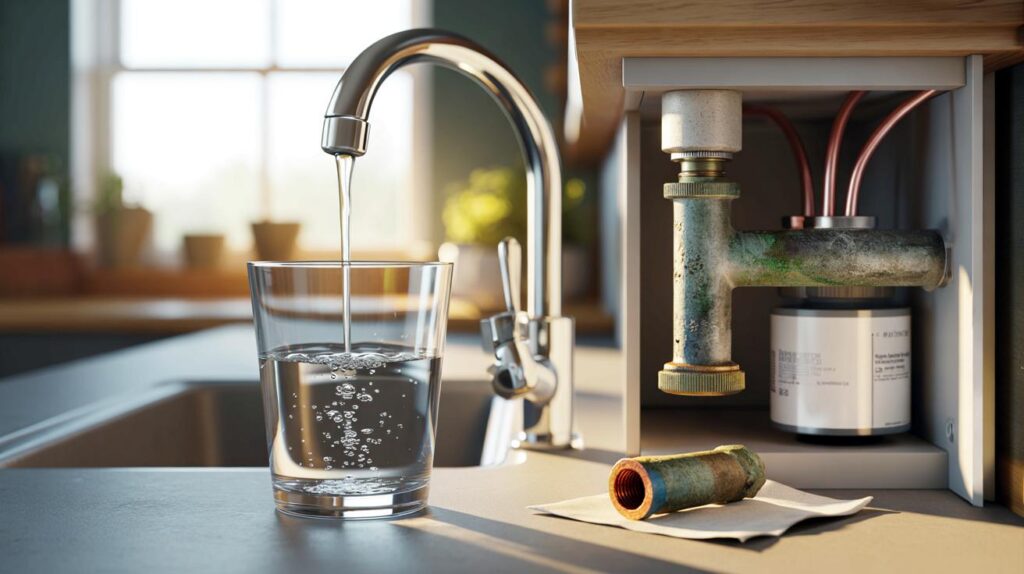
You turn the cold tap and trust what comes out. That trust was built over decades, yet the pipes under our streets — and inside our walls — are older than many of us. Experts say that’s where the story of “safe” gets complicated.
The kettle clicked on at 7.04am, the kitchen window fogged by the first proper chill of autumn, and the glass filled with water that looked like glass always does — bright, innocent, unremarkable. Two sips in, there was the faintest tang, a curling whiff of swimming-pool at the rim, and a thought you can’t un-think once it arrives: what, exactly, is in here. A neighbour mentioned their Victorian terrace still has a lead service pipe out front, and the builders on the corner struck a main last week, turning the street into a river for an hour. You stare at the tap and try to hear the century inside it. It makes a clean sound, which means nothing at all.
What’s really in the glass?
Most mains water in the UK meets strict standards, and tests show compliance above 99% year after year. The bit that doesn’t get headlines is the journey from the water main to your mouth, where ageing service lines and internal plumbing can quietly change the chemistry. **UK water is among the safest on the planet, yet old pipes are a wildcard.**
Ask anyone who lives in a pre-1970s home and they’ll mention “that metallic morning taste” after the taps sit all night. A South London parent sent off a first-draw sample and a flushed sample to a lab; the first showed a small but detectable level of lead, the second dropped to near-zero after two minutes of running. Same kitchen, same day, different story told by a little patience.
Here’s why it happens. Treatment works hard to remove pathogens and keep a protective balance, leaving a tiny residual disinfectant to stop bugs growing on the way to you. Once water rests inside old lead or copper pipes, or behind dead legs in a maze of household plumbing, it can pick up metals, fine rust, or halo the smell of chlorine. Stagnation turns tap water into tap chemistry, and it doesn’t need to be dramatic to be real.
When a home filter makes sense
Start with the facts close to home. Read your local water quality report, look up lead risk guidance for your postcode, and if your property predates the 1970s, consider a targeted test for lead at the kitchen tap using a first-draw sample. Then match solutions to problems: carbon block filters reduce taste, odour, some pesticides and many industrial chemicals; reverse osmosis units push further, cutting a wide range of dissolved contaminants; specialist cartridges tackle nitrates or PFAS where present. Look for NSF/ANSI marks (42/53/58/401) rather than marketing poetry.
We’ve all had that moment when a glass smells a bit like the leisure centre. Flushing the cold tap for 30–60 seconds before the first drink of the day can drop metals and stale flavour, and using only cold water for drinking and cooking avoids extra leaching from hot pipes. Let’s be honest: nobody does that every day, which is exactly why a good under-sink filter with a change reminder earns its keep — especially in older homes or where an infant or pregnancy raises the stakes.
One thing to clear up. **Boiling does not remove lead, nitrates or PFAS — it can even concentrate them as water evaporates.** Jug filters help with taste, yet they underperform for serious contaminants unless the cartridge is designed and certified for those targets, and cartridges need timely changes to avoid becoming a petri dish.
“The pipe between the mains and your tap is the bit nobody sees — and that’s where most surprises live.”
To cut through the noise, here’s a quick pairing guide that actually maps to how people live:
- Old or uncertain pipework: carbon block certified for lead, or a compact RO unit
- Strong chlorine taste or odour: carbon block or granular activated carbon
- PFAS flagged locally: high-quality carbon block rated for PFAS or RO
- Microbiological risk on private supplies: UV disinfection plus appropriate filtration
- Hard water limescale: softener for appliances; for drinking, limescale is aesthetic
The bigger picture
There’s a quiet paradox to tap water. The system works so well that trust is the default, yet the last metres of pipe can turn certainty into a shrug. The smartest move isn’t panic, it’s precision: know your house, read your report, test if your place is old or your gut nags, and choose a filter only if it solves a specific, measured issue. **Old pipes can make safe water a moving target, and a small, smart habit beats a big, blind worry.**
| Key points | Details | Interest for reader |
|---|---|---|
| Ageing pipes change the risk | Lead and metals leach during stagnation, especially in pre-1970s homes | Explains why water can taste off first thing and when a flush helps |
| Match filters to problems | NSF/ANSI 42/53/58/401 certifications map to specific contaminants | Stops guesswork and avoids paying for the wrong kit |
| Habits are half the fix | Use cold water, brief flush in the morning, change cartridges on time | Easy wins that make the daily glass more consistent |
FAQ :
- Is UK tap water safe to drink?Yes for most people and places, with high compliance to standards; older plumbing can add localised risks that a brief flush or a targeted filter can reduce.
- Do I need a lab test at home?If your property is pre-1970s, you’re on a private supply, or you have a specific concern like lead, a first-draw lab test at the kitchen tap is a sensible one-off.
- Will boiling remove lead or PFAS?No. Boiling can kill microbes but it won’t remove metals or PFAS, and it may concentrate them slightly.
- What’s the best all-round filter?There isn’t a universal “best”; a carbon block is great for taste and many chemicals, while reverse osmosis is broader but slower and wastes some water.
- Why does my water taste like chlorine?It’s the disinfectant residual doing its job; a carbon filter or a short flush usually clears the flavour.



Now I’m side‑eyeing my tap, thanks. Guess the century inside it has a louder voice than I thought.