
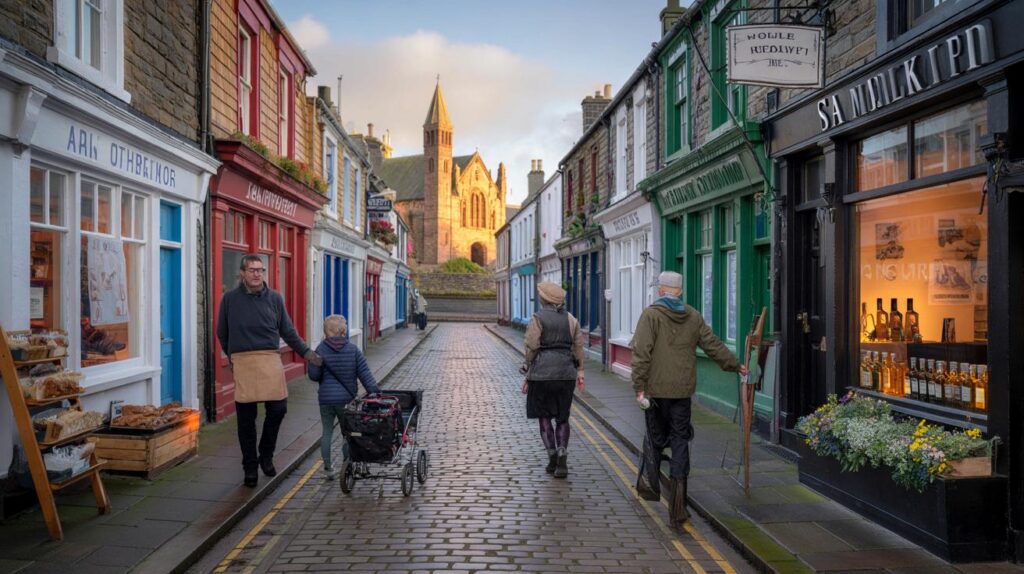
Seabirds wheel, red sandstone glows, and a single street funnels island life into one colourful spine of shops and stories.
In 2019, Kirkwall’s main street was crowned the most beautiful in Scotland by a public vote. The title stuck, not as a mere rosette, but as proof that a compact island town can keep its commercial heart beating without surrendering its character.
Where history meets daily life
Kirkwall sits on Orkney’s largest island with a street that runs south from a lively harbour into the town’s historical core. The name, drawn from the Old Norse Kirkjuvagr, means “church on the bay”, and the meaning still fits. The street draws you towards Saint Magnus Cathedral, a Romanesque landmark built in red and yellow sandstone. The building took centuries to complete and it still anchors the town’s skyline, its stonework catching the shifting light off the water.
Families gravitate to the Orkney Museum nearby, where objects span from the Stone Age to the present day. The museum’s breadth adds depth to a visit, stitching Kirkwall’s retail rhythm into a wider story of seafaring, farming and craft. This mix of heritage and day-to-day trade sets the town apart. It looks good, and it works hard.
In a Scotland-wide poll, Kirkwall’s high street took 21% of the vote in 2019 — a rare blend of beauty and usefulness.
Shops that refuse to fade
According to Orkney’s own figures, roughly 50 independent businesses operate along Kirkwall’s central spine. The range is striking. Butchers and bakers share frontage with distilleries, garden suppliers and art galleries. The offer feels personal because so many stores are family-owned, with owners greeting regulars by name and visitors with a quick explanation of island produce.
One emblem of that staying power is William Shearer, a retailer serving the town for around 170 years. The shop is part supermarket, part hardware store and part garden centre, with a gun room that nods to rural needs. Its longevity tells a simple story: adapt a little, keep your roots, and customers return.
The result is a high street that does not act like a museum. You can buy a loaf, pick up a drill bit, book dinner, and head to a tasting without leaving the same walkable route. This density cuts out friction. It also helps businesses bounce footfall between them, as window-shoppers become diners, and gallery visitors become distillery customers.
- Roughly 50 independent firms trade on and around the main street.
- William Shearer has supplied islanders for about 170 years.
- The route is lined with cafés, restaurants, hotels and specialist shops.
- Saint Magnus Cathedral and the Orkney Museum sit steps from everyday retail.
Milestones that shaped the street
| Year | What happened |
|---|---|
| 1811 | Major harbour improvements that strengthened trade routes |
| 1885 | Scapa Distillery founded overlooking Scapa Bay |
| 1959 | Main Scapa Distillery buildings completed |
| Late 1990s | Further harbour works linked to modern traffic and cruise calls |
| 2003 | Deeper-water facilities added at Hatston, expanding capacity |
| 2015 | Scapa opened to visitors, adding tours and tastings |
| 2018 | Orkney Distillery began producing gin in town |
| 2019 | Kirkwall voted Scotland’s most beautiful high street |
A high street shaped by the sea
Kirkwall’s street plan grows from its harbour. For centuries, boats have brought goods, people and ideas to this shore, and the street reflects that traffic. The harbour now welcomes cruise ships alongside the NorthLink Ferries that run to Aberdeen and Lerwick. That mix supports shops through the seasons, balancing tourism with the needs of residents.
Engineering, too, has played a quiet role in the town’s look. Deep-water berths at Hatston allow larger vessels, which, in turn, feed customers to cafés and outfitters. Earlier improvements, including 19th-century works and late 20th-century upgrades, strengthened the quay and protected the shoreline. The result is a neat front of buildings, close to the water yet resilient to island weather.
A single, walkable route runs from the harbour past hotels, eateries and independents, serving about a third of Orkney’s residents.
How people use the street
Locals treat the high street as a working corridor. Children spill out after school for snacks. Tradespeople strip off wet weather gear in hardware aisles. Friends swap news under the cathedral clock. Visitors fold into that rhythm quickly, because the route requires no complicated map. You can take it at a slow stroll and still tick off errands, meals and sightseeing.
The place rewards curiosity. Shop windows change with the season. Butchers push island beef and lamb. Bakers set out oatcakes and bannocks. Art shops turn driftwood and stone into small pieces you can carry home. Gin, whisky and beer tastings punctuate a day’s walking, with Scapa’s history adding depth and the younger Orkney Distillery signalling fresh energy.
A weekend on one street
- Morning: start with coffee near the harbour, then wander towards Saint Magnus Cathedral.
- Late morning: move through the Orkney Museum for a sweep of Neolithic to modern artefacts.
- Lunch: pick a café that uses local produce and sit by a window facing the flow of pedestrians.
- Afternoon: browse independent galleries and bookshops; pick up outdoor supplies if you plan a coastal walk.
- Late afternoon: take a tour or tasting at Scapa or the town gin distillery, time permitting.
- Evening: settle into a restaurant by the harbour and watch ferries and fishing boats trade places.
Why readers keep returning
Beauty alone does not keep tills ringing. Kirkwall’s appeal rests on something more practical. The street is compact, safe and useful. It holds enough variety to satisfy residents and enough character to make visitors plan a second day. Businesses benefit from that balance. A strong Business Improvement District has helped coordinate efforts, tidy public spaces, and support events that bring people out in all weather.
Other towns may recognise pieces of this model. Mix heritage with modern retail, reward independent ownership, keep the street human in scale, and fix the basics — paving, signage, lighting, benches, bins. When cruise calls or ferry timetables change, the town’s shops still serve their neighbours first. That resilience shows in the longevity of firms and the steady hum of trade between October storms and summer light nights.
Kirkwall’s lesson is simple: invest in people and place, and a beautiful street becomes a busy one.
Helpful context before you go
Weather shapes days here. Layers, windproofs and sensible shoes make the difference between a brief dash and a relaxed wander. Book ahead for distillery tours during peak season. Ferries can sell out on popular weekends, so check schedules to Aberdeen or Lerwick if you plan a wider itinerary. The town’s pavements are generally level, and many venues welcome prams and mobility aids, but older buildings can have narrow doorways.
If you collect local goods, plan a budget and a small bag for food items at room temperature. Spirits and glassware travel best with protective wrapping from the shop. If you enjoy photography, early morning and late evening cast warm light on the cathedral sandstone and the harbour frontage, and the single street gives long sightlines for people-watching without crowding.



Adding Kirkwall to my itinerary—coffee by the harbour, Orkney Museum, then a Scapa tasting sounds like a perfect day 🙂 Does the cathedral allow quick visits between tour slots?
21% in a 2019 poll still feels thin—was the vote regional or UK‑wide, and how many people actually took part?