
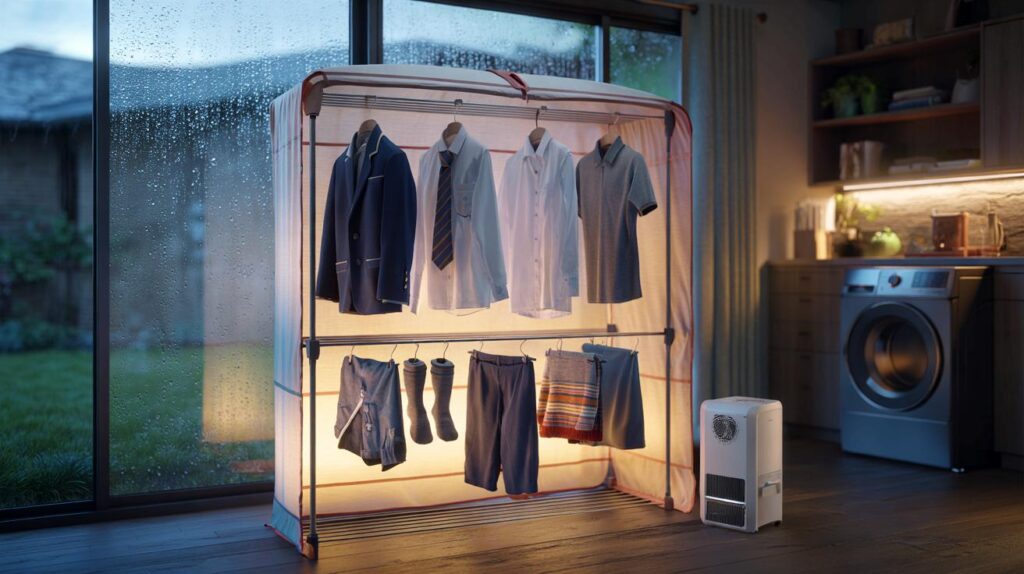
Autumn rain, steamed windows and damp socks are back. Families need a faster, cheaper way to beat the indoor drip.
As showers roll in and daylight fades, laundry piles start to linger and radiators vanish under damp clothes. A heated clothes airer promises a fix that doesn’t torch your energy budget or your patience.
Why people are talking about heated airers
Shorter days leave washing lines useless, and the tumble dryer can sting your bill. Many households now dodge radiator drying because it traps moisture indoors, nudging up condensation and mould risks. A plug-in heated airer aims for a middle ground: gentle heat, steady airflow and manageable running costs.
Running costs matter: Lakeland says its 3‑tier heated airer can cost around 9p per hour to run, depending on your electricity rate.
The headline idea is simple. Warm rails raise the temperature of fabrics, evaporation follows, and a roomy frame spreads garments so air can do the rest. Heat output is modest, yet you feel a noticeable warm haze in the room while it runs, which takes the edge off a chilly evening.
What the lakeland unit actually offers
The 3‑tier model gives you breadth and height, not just heat. It is built for whole‑family loads rather than a token pair of socks.
- Capacity: up to 15 kg of laundry on about 21 m of drying space.
- Form factor: three tiers of heated bars; it folds flat to roughly 8 cm for slimline storage.
- Optional cover: traps warm air and speeds evaporation, especially for heavy cottons.
- Room warmth: useful background heat while drying, without firing up central heating.
Users drape items evenly, plug in and leave it to work for a few hours. Towels and bedding usually demand the longest time; lighter fabrics move faster. The cover helps cut the waiting, particularly in rooms with limited airflow.
Key numbers: 15 kg capacity, about 21 m of rails, folds to roughly 8 cm, designed for multi‑load weeks.
How the bills stack up
Heated airers typically sip power compared with a dryer. If you assume a draw in the 300–330 W range, the cost per hour is modest at typical UK unit rates.
| Unit rate (p/kWh) | Assumed draw (W) | Cost per hour | Approx. 4 hours |
|---|---|---|---|
| 22p | 300 W | 6.6p | 26.4p |
| 28p | 300 W | 8.4p | 33.6p |
| 35p | 300 W | 10.5p | 42.0p |
Compare that with a tumble dryer cycle that can use around 3–5 kWh. At 28p per kWh, that’s roughly £0.84–£1.40 per load. The airer takes longer, but it often still wins on cost, especially for smaller mid‑week loads and school uniforms.
Price cuts and timing
Lakeland has been promoting money‑off deals on several heated airers, with reductions advertised up to 20%. The push lands just as parents face back‑to‑school uniforms, rugby kits and darker evenings. If you have been tempted before, a double‑digit discount changes the maths for a lot of households.
Drying results in real homes
Results depend on fabric type, room temperature and ventilation. Cotton towels and thick hoodies need patience. Shirts, underwear and synthetics turn around faster. The cover helps hold warm air near the rails, and a small desk fan or cracked window improves moisture escape. Position the airer in the room you actually heat; the background warmth shaves minutes and reduces lingering damp.
- Spin speeds: aim for the highest spin your machine allows to cut drying time.
- Spacing: leave a finger’s gap between items so warm air can circulate.
- Flipping: turn heavy garments halfway through to even out dry spots.
- Zips and seams: open them; trapped fabric slows evaporation.
- Cover use: zip it for towels and bedding; leave a gap for ventilation.
Tip: pair the airer with a low‑setting dehumidifier or a cracked window to reduce condensation and speed drying.
Safety and practicalities
Keep the airer on a level surface and away from trailing cables. Do not drape garments over the plug or power lead. Avoid blocking the entire frame with a non‑breathable sheet; warm air needs an exit. Respect the 15 kg limit. If young children or pets roam, choose a corner where it cannot be knocked.
Who gains most from a heated airer
Flat‑dwellers without outdoor space, shift workers who wash late, and families tackling uniforms in poor weather. People who want to keep the boiler off for longer will value the room‑warming side effect. Carers managing frequent light loads also benefit, because they can run short sessions without the “full cycle” mentality of a tumble dryer.
What a heated airer won’t do
It won’t replace a proper space heater. Heat output feels pleasant, but it is gentle. It won’t solve chronic damp by itself; you still need ventilation. And it won’t match a premium heat‑pump dryer for speed on bulky bedding. The point is control and cost per hour, not raw power.
Alternatives to weigh
- Heat‑pump tumble dryer: far cheaper to run than old vented models, faster than an airer, but a higher upfront cost.
- Unheated airer plus dehumidifier: efficient combo for well‑sealed homes; the dehumidifier captures moisture and adds gentle warmth.
- Ceiling pulley maid: frees floor space and uses rising warm air, great in tall kitchens or utility rooms.
- Heated towel rail: perfect for small items and bathrooms, limited capacity for family loads.
Numbers you can use before you buy
Time your current routine. If a radiator setup leaves clothes damp after six hours, you are burning heating time and risking condensation. A 300 W heated airer running for four hours uses around 1.2 kWh. Multiply that by your tariff to get the likely cost per load. If the figure is under half your dryer’s per‑cycle cost, you will feel the difference by the second month of wet weather.
Think storage and workflow. A unit that folds to about 8 cm slides behind a door or wardrobe. That matters in small flats. Add the cover if you handle towels often or your home runs cool. If you wash bulky bedding weekly, keep a local laundrette or monthly dryer session for those outliers, and let the airer handle the rest.



9p an hour for Lakeland’s 3‑tier airer to keep uniforms dry without cranking the boiler? I’m in. Anyone tried the cover—does it actually speed up towels?
Sounds great until the living room turns into a steam spa. Do you really avoid condentation with just a window cracked? I’m sceptical tbh.