
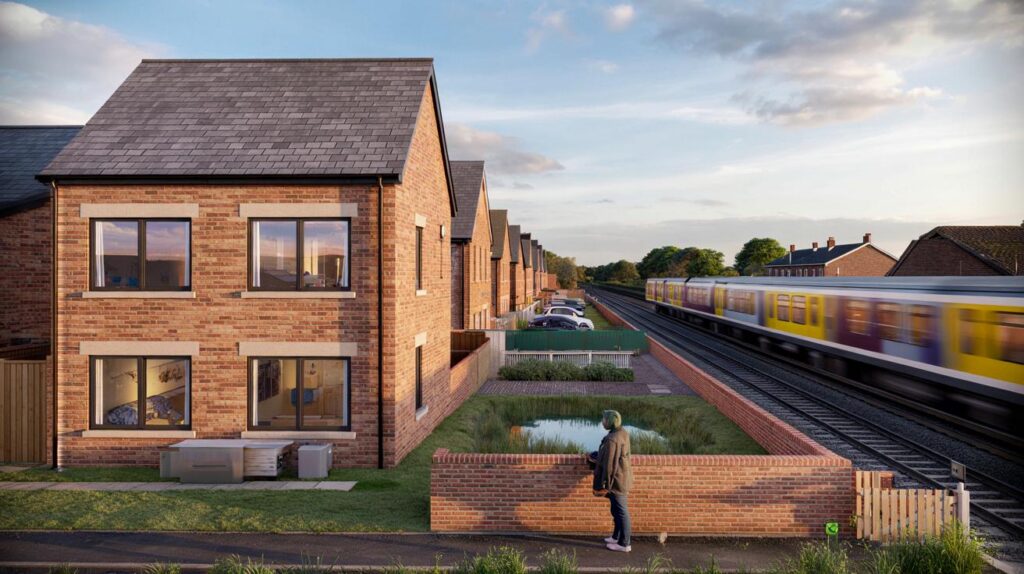
Families weighing a move to Lodge Road face a clash of promises, price tags and trains as plans near a vote.
Next week councillors will decide whether 81 homes and new commercial space can rise beside Staplehurst railway station, with big trade-offs on noise, traffic and funding.
What the proposal includes
The scheme covers 4.5 hectares of greenfield land on the west end of the Lodge Road industrial estate. The railway runs along the northern edge. The plan sets out 81 homes and an adjacent block of light industrial units.
The housing application is detailed. The commercial element remains in outline. The indicative commercial plan shows a 1,000 sqm building split into four units with 20 parking spaces. The developer is Civils Contracting Ltd, which took over the file after Ilke Homes Land Ltd entered administration last year.
About one hectare would stay as public open space. Designs include two neighbourhood play areas, footpaths and a landscaped buffer to the railway. Homes would run on electricity only. Air source heat pumps would provide heating and hot water. Gas will not be installed.
Noise, windows and walls
Rail services and neighbouring industrial activity push background noise above target levels for several plots. The developer’s solution relies on acoustic design, including a 1.8m brick or stone barrier in certain gardens and sealed façades in the most exposed dwellings.
Some households would need mechanical ventilation and fixed-shut windows facing the tracks to meet indoor noise targets.
That approach would allow habitable rooms to meet internal standards without relying on open windows. The trade-off raises questions about summer comfort, maintenance and residents’ preference for fresh air. The company argues acoustic upgrades, orientation and the courtyard layout will soften exposure for the wider estate.
Viability row and the missing affordable homes
The Local Plan allocates the site for a mix of homes and commercial floorspace. Civils Contracting says delivering both tips the sums into the red. The firm points to three cost pressures. The site needs a surface water pumping station. It also needs a new electricity sub-station. The road base on the approach requires reinforcement.
Council-appointed consultants tested the financial model. They agreed the scheme only works on paper if it omits on-site affordable housing and drops the usual county contributions. In viability language, “works” means the developer cannot achieve the reference profit margin of around 17% on cost if those obligations are added.
No affordable homes are proposed at this stage, and standard county contributions fall away under the current viability findings.
Planning officers accept the position in principle, given the evidence. To keep options open, they want a legal clause. If the commercial block never comes forward, the developer would pay an off-site sum towards affordable housing elsewhere.
Traffic, access and school places
A key condition in the site allocation calls for a road connection through to the Dickens Gate estate to the west. The parties have not reached agreement on land and access. As a result, all vehicles would use Lodge Road. KCC’s highways team predicts longer queues at the Station Road/A229 junction during peaks. It still considers the impact within acceptable bounds.
Kent County Council seeks more than £1 million for schools and services. The borough suggests the Community Infrastructure Levy could address that list. The developer’s viability case says it cannot fund both infrastructure and the full wish list. The planning committee must judge the balance.
The KCC funding wish list
| Service | Requested sum |
|---|---|
| Primary education | £476,321 |
| Secondary education | £468,975 |
| SEND provision | £49,265 |
| Community learning | £3,010 |
| Children’s services | £6,516 |
| Libraries | £5,511 |
| Adult social care | £15,917 |
| Waste collections | £4,576 |
| Total | £1,030,091 |
Wildlife, green space and low-carbon kit
Surveys recorded great crested newts across the land. The developer plans to keep the existing pond and add a second pond. It also proposes payments to Natural England to create or enhance off-site ponds. The package aims to produce a 26% biodiversity net gain, driven by new habitat and planting.
The landscape plan sets out two community green areas and play parks. A path network would support walking and cycling within the site. Planting along the sensitive edges seeks to reduce overlooking and visual impact for neighbours.
Who supports and who objects
Network Rail has concerns about extra footfall across the nearby unmanned level crossing. The applicant says it can discourage cut-throughs by building a wall between the estate and the public footpath. Thirty-two individuals have lodged objections with the council.
Staplehurst Parish Council wants refusal. It lists design, safety and service pressures. These points shape the local debate:
- No one-bed starter homes appear in the mix.
- Lodge Road would act as a bottleneck without the western link.
- Traffic could push extra strain onto the Marden Road/A229 crossroads.
- Lodge Road and Station Road already carry heavy flows at peaks.
- Community services in Staplehurst feel stretched today.
- Parts of the site flood frequently after heavy rain.
- Housing affordability is a major local concern and remains unaddressed.
What “viable” really means for buyers
Viability tests do not declare a cash loss. They judge whether the project meets an industry benchmark return. In practice, this can strip out affordable housing and council contributions when costs climb. The committee can still require review mechanisms. Those triggers can revisit affordable housing if build costs fall or sales values rise before completion.
Noise mitigation also deserves scrutiny. Mechanical ventilation improves indoor air quality with windows shut. It adds filters and fans that need maintenance and electricity. Buyers should ask about running costs, summertime overheating risk and whether quiet, openable windows exist on façades shielded from the tracks.
Questions to ask before reserving a plot
- Which rooms face the railway, and what glazing and ventilation serve them?
- How will the 1.8m garden wall align with my boundary and views?
- What are the predicted internal noise levels by room, day and night?
- What is the estimated annual cost of the heat pump and ventilation system?
- Will the commercial units be built at the same time as the homes?
- Is there a plan for a future link road if land agreements change?
What happens next
Maidstone Borough Council’s planning committee will consider a recommendation to approve the housing in detail and the commercial space in outline. Officers accept the viability case on current evidence. They also seek legal safeguards to capture an affordable housing payment if the job changes shape later.
The choice now sits between a rail-side scheme with firm noise controls and funds squeezed elsewhere, or a redesign that may cut housing numbers to free up budget for public services. Either route carries costs, and residents living near the station will feel the consequences first.



How will “fixed-shut” windows and mechanical ventilation work in practice? Is it MVHR with summer bypass or just MEV? What are the predicted overheating hours (CIBSE TM59) for top-floor bedrooms on hot nights? And who pays for filter changes and fan electricity—service charge or owner? Without quiet, openable windows on shielded façades, this feels risky.
No affordable homes proposed? So “viable” means the 17% developer margin is ring‑fenced while local affordablilty isn’t. We’ve seen this movie. If sales values rise, will the review actually claw anything back—or will the spreadsheet say “no headroom” again? Also, the £1m KCC ask gets shaved to what, exactly? Colour me sceptical.