
New-build promises meet hard realities in a corner of Kent, where price, noise and traffic collide with green ambitions.
Plans for a 4.5-hectare estate off Lodge Road have reached a decisive moment. The proposal mixes 81 homes with small commercial units beside the railway. It offers parks and heat pumps, yet also sealed windows, a busy junction and no on-site affordable housing.
Homes near the tracks, with limits
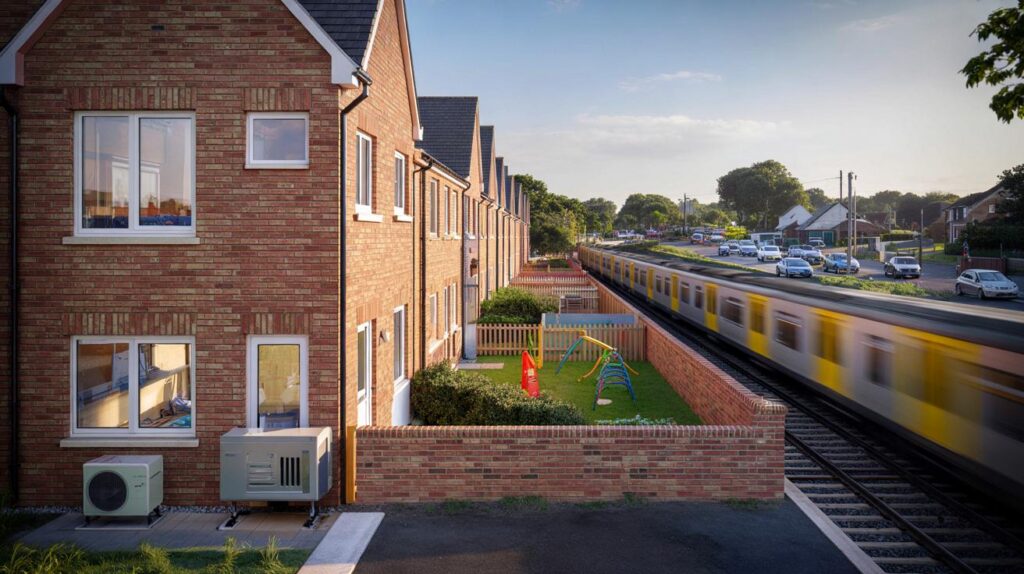
Parts of the estate sit close to the railway line and an industrial area. Acoustic reports submitted with the application say noise would exceed standards if residents kept windows open. To hit the required internal levels, a proportion of homes would be delivered with dedicated ventilation systems. In practice, that means some future occupants will rely on mechanical ventilation instead of fresh air through the window.
Boundary treatments form another layer of control. The developer proposes 1.8m brick or stone walls in selected rear gardens to shield outdoor spaces from passing trains and yard activity nearby.
Several plots are earmarked for “windows closed” living, with mechanical ventilation and acoustic boundary walls to keep internal sound within target levels.
Where the new homes would sit
- Location: west end of the Lodge Road industrial estate, north of Staplehurst
- Size: 4.5 hectares, bordered to the north by the railway
- Homes: 81 dwellings proposed, with a mix of houses
- Open space: around 1 hectare set aside, including two play areas and community greens
- Access: all vehicles via Lodge Road; no link through to the neighbouring Dickens Gate estate
Viability crunch and the missing affordable homes
The developer, Civils Contracting Ltd, says the scheme becomes unprofitable if it funds both affordable housing and the usual county council contributions. Their cost plan lists a new surface water pumping station, a new power sub-station and reinforcement of the road base as abnormal items. They also argue the Local Plan’s requirement for commercial floorspace adds cost and risk in a market with thin local demand.
Maidstone Borough Council commissioned independent consultants to test these numbers. The verdict: the scheme is only considered “viable” if there is no affordable housing and no Kent County Council contributions via planning obligations. In planning finance, “viable” refers to an industry benchmark of about a 17% developer return. It does not mean the project would lose money if it paid more; it means the return would fall below that benchmark.
Current appraisals back a zero on-site affordable quota. If the commercial units never come forward, officers want a legal trigger for a later payment towards affordable housing elsewhere.
The council’s planning officers, citing the viability evidence, recommend approval without affordable homes on the site. They also seek a mechanism to secure a contribution if the business units are dropped at a later stage.
What the county wants, and who would pay
Kent County Council’s highways team accepts the traffic impact overall, although they expect longer peak queues at the Station Road/A229 junction. Separately, KCC has itemised education, SEND and other service costs that would usually fall to the scheme via planning obligations. These total more than £1 million.
| Requested contribution | Amount (£) |
|---|---|
| Primary education | 476,321 |
| Secondary education | 468,975 |
| SEND provision | 49,265 |
| Community learning | 3,010 |
| Children’s services | 6,516 |
| Libraries | 5,511 |
| Social care | 15,917 |
| Waste | 4,576 |
Officers suggest these pressures could instead be met by the Community Infrastructure Levy payable on the development. That shifts the debate from negotiable obligations to a set levy, although the total pot and local spending priorities still matter to residents weighing school places, library space and road safety.
Traffic, safety and community concerns
Staplehurst Parish Council has lodged a detailed objection. It says the layout offers no one-bed starter homes. It warns Lodge Road will become a bottleneck if no link is provided through to Dickens Gate. The Marden Road/A229 crossroads already feels the squeeze at rush hour, according to councillors. They also cite frequent surface water on the land, cumulative strain on community facilities and the lack of on-site affordable provision in a village where prices stretch local incomes.
Network Rail raises a separate risk. The site lies beside an unmanned foot crossing. More residents could mean more foot traffic across the tracks. The applicant proposes a wall to divert people away from the crossing and onto safer routes.
Highways models accept longer queues at peak times. Parish voices warn of a daily pinch-point and more pressure at the A229 junction without the missing link road.
The planning file also lists 32 individual objections. Many point to noise, congestion and services under pressure. Some mention flood risk and the day-to-day reality of living beside a working railway.
Green credentials and wildlife trade-offs
The homes arrive with no gas connection. Heating would come from air source heat pumps, which cut local emissions and open the door to lower-carbon electricity in future. Around a hectare stays as green public space, with two play areas and landscape buffers along sensitive edges. The plans keep one existing pond and propose another for drainage and habitat.
Ecology surveys found great crested newts across the site. They are protected. The applicant proposes off-site mitigation through contributions to Natural England’s scheme for creating and managing newt ponds elsewhere. The overall package claims a 26% biodiversity net gain, on paper.
What happens next
A detailed application for the housing and an outline for the commercial space go to Maidstone’s planning committee next week, with a recommendation to approve. The file dates back to June 2023 under a previous promoter, Ilke Homes Land Ltd, which later entered administration. The landowner and joint applicant, Civils Contracting Ltd, has since taken the plans forward under application 23/502352.
If you are thinking of buying here
- Noise and comfort: sealed windows improve internal sound levels, but they reduce natural ventilation. Check the ventilation system’s noise, filter costs and summer performance.
- Acoustics: ask for predicted internal decibel levels, glazing specifications and garden noise readings. An acoustic wall helps, but its benefit depends on height, gaps and garden layout.
- Travel patterns: proximity to the station is a plus for commuters. Expect longer car queues at peak periods on Station Road and the A229.
- Value and resale: homes with mechanical ventilation and limited window opening can sell well, but some buyers hesitate. Ask your surveyor about market comparables near busy rail lines.
- Charges and levies: CIL is paid by the developer, not residents, but it shapes what the council funds locally. Ask what projects are earmarked in the village.
Extra context you can use
How loud is too loud? As a guide, many UK schemes target around 30 dB LAeq in bedrooms at night and 35 dB in living rooms by day. Near railways, that typically means high-spec glazing and controlled ventilation. A 1.8m solid wall can cut garden noise by 5–10 dB if it blocks the line of sight to the source and has no gaps. Triple glazing can add several decibels of reduction over standard double units, though frame quality and trickle vents matter as much as the panes.
Ventilation systems vary. Basic systems draw in filtered air and extract stale air. More advanced kit recovers heat, cutting winter bills. Ask whether your home will get mechanical extract only or whole-home heat recovery. Check summertime purge options. If windows must stay closed on noisy façades, look for extra background ventilation rates or a summer bypass in heat-recovery systems to avoid overheating.
On planning finance, two mechanisms sit side by side. Section 106 obligations are negotiated and can flex when viability is tight. The Community Infrastructure Levy is a set tariff per square metre, subject to exemptions and reliefs in specific cases. The split affects which local projects get funded and when. Residents often see the outcome in school capacity, library hours and road schemes years after homes complete.
Commercial space at the edge of villages can struggle if local demand is thin. If the four-unit, 1,000 sqm block stalls, the council wants a review clause that redirects value to affordable housing. That kind of “fallback” protects policy aims when market conditions shift. Buyers should watch committee conditions for any phasing rules that tie housing handovers to delivery of the business units, highways works and the green spaces.
Wildlife mitigation through off-site licensing is common for great crested newts. It funds new or improved ponds within the district. For families, that means construction can proceed while ecology duties are met elsewhere, but habitat benefits won’t sit on your doorstep unless the plan also delivers on-site features such as the retained pond, native planting and dark corridors for nocturnal species.



If bedrooms hit 30 dB at night only with sealed windows, how do they stop summertime overheating? What’s the spec on the ventilation units (noise in dB, filters, maintenance costs), and is there a purge mode that doesn’t force me to open the ‘noisy’ facade? Asking as someone who’s lived by a line—mechanical ventliation can hum more than you think.
Buying a ‘windows closed’ home by the tracks feels like camping next to a rave with noise‑cancelling headphones. If the MVHR is quiet and there’s a summer bypass, maybe… otherwise it’s a no from me 🙂