
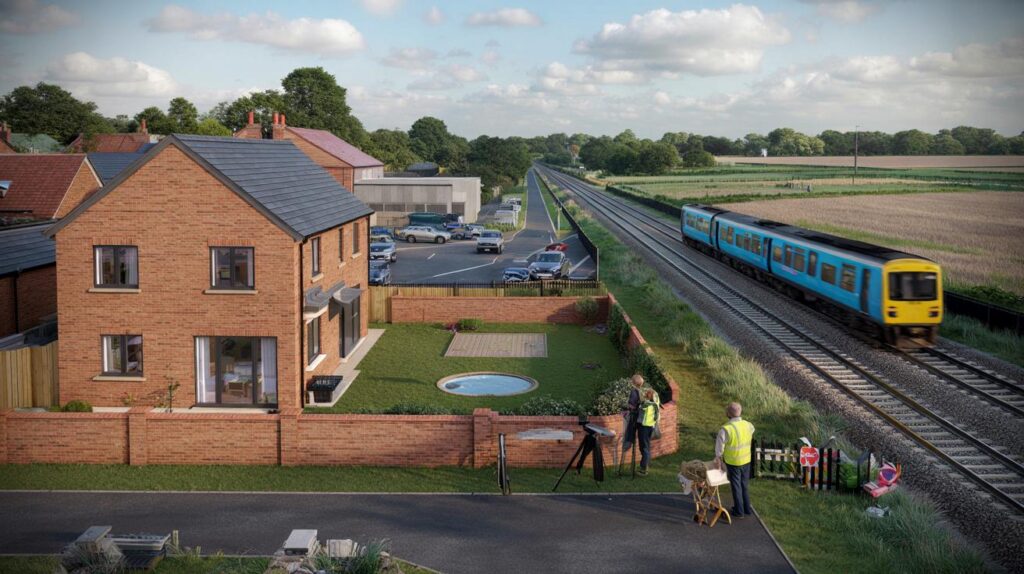
A field beside the railway in Staplehurst may swap crops for cul‑de‑sacs, play parks and a fierce local argument.
Next week, Maidstone councillors will consider plans for 81 homes off Lodge Road, a small commercial hub, and a tangle of costs, noise rules and legal hooks that could shape daily life for new neighbours.
Noise rules could lock windows shut
The site sits hard up against the railway line and an industrial estate. Acoustic surveys show trains and nearby operations would push sound levels past guidance inside some plots if residents open their windows. To meet standards, the developer proposes mechanical ventilation and enhanced glazing in a share of the homes, with advice that occupants keep windows closed for noise control.
Designers also propose a 1.8m brick or stone wall in selected gardens to shield outdoor spaces. The scheme would add a wall between the estate and the public footpath near the unmanned rail crossing to discourage cut‑throughs that might increase foot traffic on the tracks.
Several homes would rely on built‑in ventilation and acoustic glazing, with guidance not to open windows for noise management.
- Mechanical ventilation specified for plots closest to the line and industrial units
- 1.8m garden walls proposed as physical noise barriers
- Estate boundary wall intended to deter access to the nearby unmanned crossing
Money, viability and the £1m question
Why the developer says the sums don’t add up
The Local Plan allocation requires both housing and commercial floorspace. The applicant argues there is little demand for the employment units and says the mixed brief, plus unusual infrastructure, drags the site below expected returns. They list a new surface‑water pumping station, a power sub‑station and road substructure reinforcement as cost drivers.
Independent consultants appointed by Maidstone Borough Council tested the figures and concluded the scheme is only “viable” on industry benchmarks if it provides no affordable housing and pays no standard county contributions. In consultancy shorthand, “viable” here means it meets a modelled 17% developer return; it does not automatically mean the scheme would make a cash loss with obligations attached.
Planning officers recommend approval with zero on‑site affordable housing and no standard county contributions on current figures.
What Kent County Council wants
Kent County Council’s position is clear: it will object unless it secures more than £1 million for services. The council suggests some or all of this could come via the Community Infrastructure Levy, a charge that sits apart from negotiated planning obligations.
- £476,321 for primary education
- £468,975 for secondary education
- £49,265 for SEND provision
- £3,010 for community learning
- £6,516 for children’s services
- £5,511 for libraries
- £15,917 for social care
- £4,576 towards waste collections
Officers also want a legal trigger: if the commercial units never arrive, the developer would pay a commuted sum for affordable housing elsewhere to reflect the altered mix.
Access and traffic
No link to Dickens Gate
The Local Plan envisaged a road connection west to the Dickens Gate estate. Talks between the parties failed, so every car and van would use Lodge Road. Kent Highways accepts the impact as manageable overall, while acknowledging longer peak‑time queues at the Station Road/A229 junction.
The parish council sees trouble brewing. It warns of a bottleneck on Lodge Road, pressure on the Marden Road/A229 crossroads, and congestion on Station Road. Without the link road, residents fear rat runs and longer journeys.
Green promises and protected newts
The 4.5‑hectare greenfield site would keep around one hectare as public open space, including two play areas and new landscaping. Homes would use air‑source heat pumps with no gas mains. The plans retain the existing pond and add another. Great crested newts, a protected species, live across the site; the applicant proposes contributions to Natural England to create or restore habitat off‑site.
The developer forecasts a 26% biodiversity net gain once planting, ponds and open space are factored in.
Who supports and who objects
Staplehurst Parish Council urges refusal. It cites a lack of one‑bed starter homes, road congestion, flood risk on the site, pressure on already stretched community facilities, and the failure to provide any affordable housing. Network Rail raises safety concerns about extra footfall near the unmanned crossing. Thirty‑two residents have lodged objections.
- No one‑bed homes for first‑time buyers
- All traffic via Lodge Road without the link to Dickens Gate
- Queues expected at Station Road/A229 and Marden Road/A229 junctions
- Flooding reported on the land
- Staplehurst services under strain
- No on‑site affordable housing proposed
What exactly is planned
The application splits in two: detailed consent for 81 dwellings and outline consent for commercial space. An indicative plan shows a 1,000 sq m building split into four units with 20 parking spaces. The site lies at the west end of the Lodge Road industrial estate, bounded by the railway to the north. The planning committee will debate the case next Thursday, with officer support to approve. The file reference is 23/502352.
| Homes | 81 (no on‑site affordable proposed) |
| Site area | 4.5 hectares |
| Public open space | About 1 hectare with two play areas |
| Commercial | c.1,000 sq m in four units (outline) |
| Access | Lodge Road only; no link to Dickens Gate |
| Noise mitigation | Acoustic glazing, mechanical ventilation, 1.8m garden walls |
| Energy | No gas; air‑source heat pumps |
| Biodiversity | 26% net gain; newt mitigation via contributions |
| County ask | £1m+ across education, SEND, libraries, social care, waste |
What buyers and neighbours should think about
Homes near railways can work well when acoustic design matches the plot. Prospective buyers should ask the sales team which houses need mechanical ventilation, what summer cooling strategy they use, and whether garden walls or landscape mounds serve as sound barriers. Acoustic double or triple glazing reduces noise but works only with closed windows; check if bedrooms have acoustically treated trickle vents and whether a “purge” strategy is in place for hot weather.
UK guidance such as BS 8233 and ProPG steers designers on internal and external sound levels. Expect planning conditions to pin down glazing, ventilation rates and fence or wall specifications by plot. Read any management plan for the new pumping station, because private estate charges usually fund maintenance of drainage, open spaces and play equipment.
How planning “viability” shapes the deal
The 17% profit threshold used by consultants functions as a benchmark. If costs rise or sales values fall, affordable quotas and contributions tend to shrink in the appraisal. If sales outperform the model or the commercial floorspace arrives at lower cost, a review clause can send money back into affordable housing or local services later. Buyers and neighbours benefit when councils write clear triggers so contributions move with the market rather than vanish.
For now, the proposal trades obligations for delivery: no on‑site affordable homes, no standard county payments, but a route to revisit contributions if the commercial phase falters. The committee must judge whether noise controls, open space and energy measures offset the missing homes that key workers and young renters hoped to see.



Buying here means you rely on MVHR or mechanical extract while being told not to open windows—how does that play during a 30°C week? If purge ventilation = open windows, doesn’t that undermine the acoustic compliance they cite from BS 8233/ProPG? Also, who pays to maintain the pump station and noise walls in 10 years—estate charges that can’t be capped?