
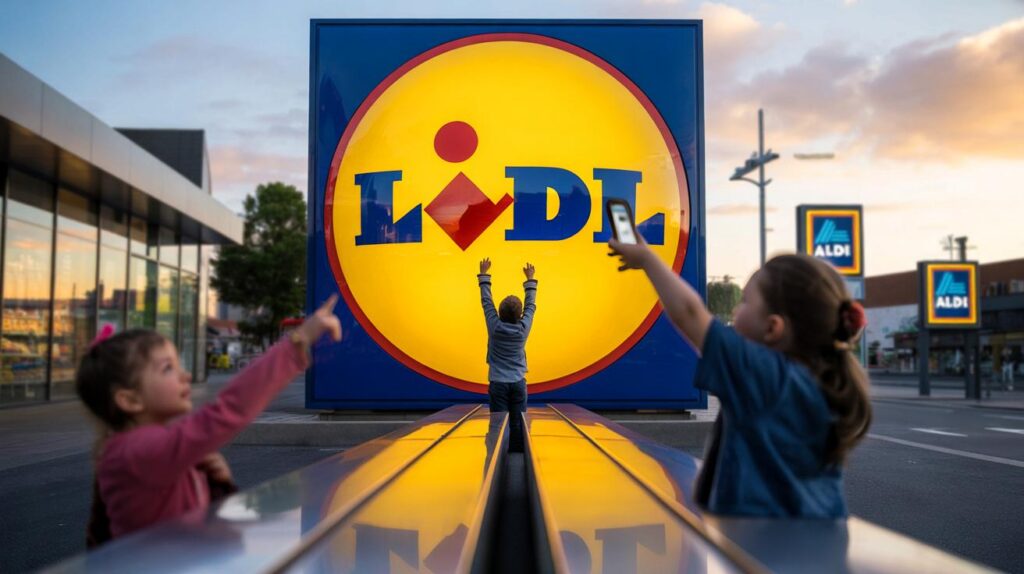
A familiar shopfront spark set bargain hunters talking, as shoppers swapped optical tricks, pronunciation tips and jokes from rival aisles.
A quick TikTok clip nudged people to look twice at Lidl’s bright sign. Within hours, phones lit up with sketches, arguments and belly laughs. What began as a throwaway remark turned into a nationwide game of “can you see it?” on the forecourt and in the fruit aisle.
What set shoppers off this week
A creator on TikTok, posting as @misskatiefett, shared a simple claim: the Lidl logo looks like a dog playing the piano. That phrasing alone primed thousands of people to reframe the shapes they already knew by heart. The debate then jumped to other platforms. Users circled edges, shaded arcs and overlaid outlines. Some saw the dog in seconds. Others stared at the sign and shrugged.
The reading follows a neat path. The red accent near the “I” becomes a paw above the keys. The two “L” shapes align like skinny piano keys. A yellow curve suggests a wagging tail. The brain knits these elements into a scene, even though the designer likely never meant it that way.
The illusion in three beats
- Red becomes paw: the small red mark reads as the dog’s lifted forepaw.
- Blue becomes keys: the two “L” glyphs form a quick row of piano keys.
- Yellow becomes tail: a curved yellow stroke completes the canine profile.
Once you spot the pianist pup, the sign will never look the same on your Saturday shop.
Aldi cracks a joke, Lidl holds its nerve
Lidl kept quiet as the chatter grew. Aldi didn’t. The rival chain leaned into the gag with a dry aside on social media: we only see it when our eyes are fully closed. The jab landed softly, and fans of both stores piled in with their own one-liners. Rivalry between the discount cousins often takes this playful tone online, and the dog-at-the-piano bit suited that tradition.
Two German discounters, one blue square, and a crowd of Brits arguing about a cartoon dog in the car park.
Why your brain suddenly sees a dog at the piano
There’s a tidy explanation: pareidolia. People spot faces, animals and objects in random patterns, from clouds to toast to corporate marks. Add a nudge from a caption and your brain’s top‑down processing does the rest. It hunts for meaning, matches fragments to learned templates, and fills gaps.
Pareidolia, priming and the power of brand shapes
Brand marks rely on simple geometry and high contrast. Those features make them durable at speed, from kerbside to flyer. They also make them fertile ground for unintended readings. The Lidl wordmark stacks hard angles, a bright yellow disc and a pop of red. Those ingredients help cashiers hand receipts fast, and—this week—help thousands of minds conjure a jaunty terrier hammering out a tune.
- Priming speeds the effect: a single sentence can tilt your perception in under a second.
- Gestalt rules apply: proximity, closure and continuity push separate strokes into one image.
- Memory finishes the job: past exposure to dogs and pianos supplies the missing detail.
No, it isn’t a secret designer Easter egg. It’s your visual cortex doing heavy lifting between the aisles.
So how do you actually say Lidl and Aldi?
The optical gag reopened an old British question: how do you say the names? Pronunciation shifts by country, and even by region. Here’s a plain guide many shoppers use.
| Country | Lidl | Aldi |
|---|---|---|
| Germany | “LEE-dl” (short final syllable) | “AHL-dee” (Al as in “pal”) |
| United Kingdom | Often “LID-uhl” (like “liddle”) or “LEE-dl” | Commonly “AL-dee” (short A) |
| France | Varies between “LEE-dl” and “LID-uhl” | Heard as “AL-dee” |
Purists will say the German forms sit closest to the brands’ roots: Aldi stems from “Albrecht” and “Diskont”, while Lidl belongs to the Schwarz Group. In everyday speech, most people default to what their mates say.
How to test the illusion on yourself and your mates
Want to measure how sticky the trick is? Set a timer on your phone and try this quick run-through before your next big shop.
- Stand at least 10 metres from the sign. Glance for half a second. Do you catch the dog?
- Look for 5 seconds. Note which shapes become the paw, keys and tail.
- Turn away and sketch the scene in five lines. Compare notes with a friend.
- Repeat after reading different prompts. Watch how wording changes what you see.
What this means for brands and buyers
Logos work hardest when you barely notice them. Familiarity shortens the time from glance to recognition, which helps queues move and ads land. The downside for marketers arrives when a fresh reading hijacks the mark. That new narrative can upstage the intended message for days. Here, the “dog at the piano” risks stealing attention from price points and promos—while boosting brand chatter for free.
For shoppers, the lesson travels well. A single hint can bias how you read labels, ratings and signs. You can guard against that nudge by asking a simple question: what would I see without the caption? That check takes two seconds and can save you from mistaken conclusions, whether you’re comparing tins or scanning a notice.
Other hidden shapes you already know
- FedEx hides an arrow between E and X, pushing a sense of motion.
- Toblerone’s mountain contains a bear, nodding to Bern.
- Amazon’s smile doubles as an A‑to‑Z arrow, promising range.
These examples are deliberate. The Lidl pup almost certainly isn’t. Both flavours of reading—planned and accidental—show how meaning clings to geometry once a viewer spots a cue.
From car parks to crisp packets, your brain edits first and asks questions later.
Want a practical takeaway for the school run or the shop floor?
Turn the logo hunt into a five‑minute game with kids. Pick three marks on the way to the till and ask what else the shapes could be. You’ll build observation skills and media literacy without a lecture. Designers can run the same drill with their teams to stress‑test marks for unintended readings that might trend for the wrong reasons.
If you’re in marketing, run a quick simulation: show your logo to 20 people with no prompt, then to 20 with a cheeky hint. Time recognition and collect the first words people say. You’ll spot where your lines and colours lead minds under real‑world pressure.



Can’t unsee the piano pup.