
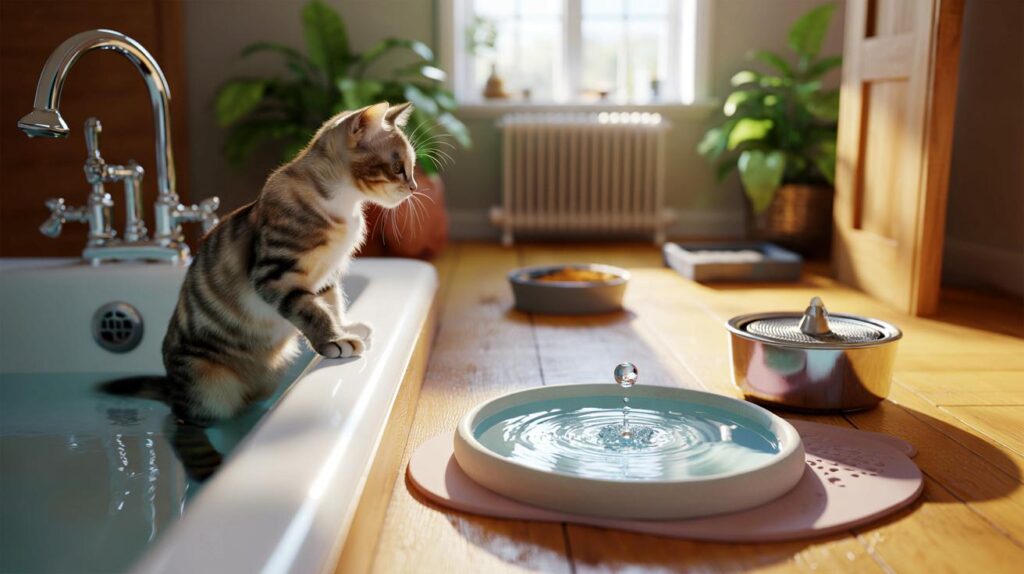
As radiators crackle back to life, a peculiar habit returns to British homes: cats loitering by the bathtub rim.
The cooler months change indoor air and routines, and many cats start to sidestep their bowls for the tub, sink or shower tray. Behaviourists point to scent, sound and placement as the culprits. Vets, meanwhile, warn that small hydration gaps can snowball into urinary trouble. Here is how the trend shapes up this season, and what you can do about it in minutes rather than months.
Why many cats shun the bowl and stalk the bath
The pull of moving water
To a cat, still water can seem stale or risky. A thin trickle from a tap sounds fresh and safe. The curved enamel of a bath keeps water cool and away from food smells. That mix feels more inviting than a lonely bowl parked beside kibble.
In feline logic, moving water signals freshness and safety, while a silent bowl can feel uncertain.
Noise matters too. A quiet glug or drip draws attention. Some cats learn to ask for a tap run because the reward is immediate and predictable.
What the bowl really smells like to a cat
A cat’s nose flags traces we miss. Soap film on the sink, a hint of bleach on your hands, plastic that clings to odours, even a ghost of yesterday’s salmon. Any of these can turn a bowl into a no-go. Bath enamel smells like, well, nothing. That neutrality wins.
Switch to neutral materials and a scent-free wash routine to strip away invisible turn-offs.
Whiskers, territory and awkward placement
Deep, narrow bowls press whiskers. That causes micro-stress. A bowl placed beside food or litter also breaks a cat’s instinct to separate eating, drinking and toileting zones. The bathroom, often quiet and cool, feels like a safe annex.
Keep water at least 2 m from the litter tray and 1 m from food to respect feline zoning.
Nine fixes you can try today
Small, precise changes beat a single grand gesture. Combine several of the steps below and review after seven days.
- Refresh water twice daily; top up to a shallow depth of 2–3 cm to expose more surface and oxygen.
- Place two to three bowls in calm spots; avoid corridors and doorways where feet and noise pass.
- Separate zones: at least 1 m from food, 2 m from litter; higher if space allows.
- Choose wide, shallow bowls (15–20 cm across) to spare whiskers; skip narrow, deep shapes.
- Use glass, ceramic or stainless steel; wash with hot water only, then air-dry; avoid scented detergents.
- Add three or four ice cubes during warm spells or when heating runs hot; many cats like cooler sips.
- Trial a fountain on a rubber mat to dampen noise; rinse weekly; change filters every 3–4 weeks.
- Offer wet food once a day if diet allows; it lifts total water intake without drama.
- Make it visible: place one bowl near a window perch or favourite resting zone to catch curiosity.
Which bowl materials work best
| Material | Pros | Watch-outs |
|---|---|---|
| Ceramic | Neutral smell, weighty, easy to clean | Can chip; check glaze is food-safe |
| Stainless steel | Durable, odour-resistant, hygienic | Can be noisy on hard floors; use a mat |
| Glass | Inert, shows dirt clearly, easy rinse | Breakable; avoid high-traffic spots |
| Plastic | Light, cheap | Holds smells, scratches harbour residue |
Set up better, fast
The five-minute placement test
Map three quiet spots your cat already uses. Lay down a non-slip mat. Place one wide bowl at each site, all with the same fresh water depth. Leave them for 48 hours without moving. Note which bowl empties fastest. Keep the winner, rotate the rest to new calm zones, and test again. This simple loop reveals your cat’s true preferences.
Calm the bathroom obsession without a showdown
Close the bathroom door only after you have deployed extra bowls. If your cat asks at the tub, guide it to the nearest new station and tap the bowl surface with a fingernail to create ripples. Reward with soft praise. Repeat consistently for a week. Many cats swap habits when the new option is just as interesting.
The seasonal angle: heat, humidity and health
Autumn heating drops indoor humidity. Drier air and a warmer house can boost water loss through respiration. Some cats drink less because bowls turn tepid and dull. Others drink more but at awkward times. Either pattern can unsettle sensitive bladders.
Vets regularly flag lower urinary tract signs in cooler months: straining to wee, frequent trips with tiny clumps in clumping litter, or vocalising in the tray. Male cats face a higher blockage risk. If you spot pain, blood or repeated attempts with little output, call your practice the same day.
Target a daily intake of roughly 40–60 ml per kg bodyweight, including moisture from food.
For a 4 kg cat, that means around 160–240 ml across 24 hours. Wet food can cover a large share. If you feed mostly dry, the placement and freshness steps above matter even more.
Data you can track without gadgets
Simple ways to measure progress
Weigh the bowl before and after 24 hours; a kitchen scale does the job. Mark a discreet line inside the bowl to see change at a glance. Count clumps if you use clumping litter; consistent medium clumps often mean steady drinking. Note the time of day your cat visits the bowl; morning-only drinkers may need an evening refresh to tempt an extra sip.
Extra angles that sharpen results
Flavour, noise and routine
Some cats accept a hint of flavour. A teaspoon of tuna water from tuna in spring water, not oil or brine, can spark interest. Offer this only once or twice a week to avoid habit lock-in. If you try a fountain, choose a quiet model and place it on cork or silicone to kill hum. Cats that fear hums will revert to the bath.
Household rules that help everyone
Keep bowls off thoroughfares to stop slips and spills. Lift bowls slightly on a stable stand for arthritic cats. Wash bowls every 24–48 hours, and replace scratched or crazed surfaces. If two or more cats share a home, add one extra station beyond the number of cats to reduce queuing and guarding.
Curious about risk balance? Running taps waste water and train attention-seeking. A one-off spend on two solid bowls and a mat often cuts bathroom trips to zero within a fortnight. For enrichment, a fountain can sit in a utility room rather than the kitchen, lowering noise and keeping fur out. If your cat still begs at the bath after a month of changes, speak to your vet or a qualified behaviourist to rule out pain, anxiety or nausea that can alter drinking patterns.



Fantastic breakdown. I’d never considered whisker stress; the 15–20 cm wide bowls and 2–3 cm water depth are great specifics. I’ll switch to ceramic and wash with hot water only, no detergent. Also moving stations 2 m from the litter and at least 1 m from food—makes sense. Refreshing twice daily seems doable. We’ll trial a quiet fountain on silicone and change filters every 3–4 weeks. This is definitley the most practical guide I’ve read this season.