
Rain-filled skies, cramped flats and damp air stall your washing. A tiny tweak to your routine brings welcome breathing space.
An at-home trick from Japan rearranges how you hang garments, boosting airflow and cutting indoor drying time without buying new kit.
Why your indoor drying takes days
Washing dries slowly when still air, low heat and high humidity trap moisture around fabric. Pack clothes together and the damp lingers. Leave them near steamy rooms and odours bloom. That stale, wet-cupboard smell signals stagnation, not freshness.
Slow drying encourages musty odours. Speeding up airflow around fabric breaks the cycle and keeps garments fresher.
Drying fast matters for comfort and hygiene. Fabrics that remain wet for too long can harbour bacterial growth and allow mould spores to thrive on nearby surfaces. You cut those risks by improving circulation and lowering indoor humidity while laundry hangs.
What the rainbow method looks like
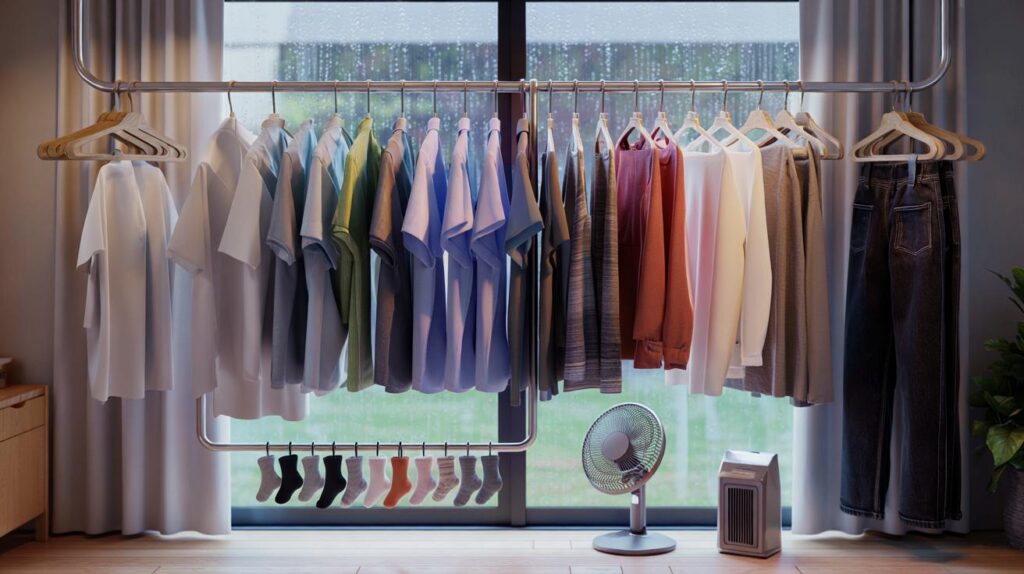
The “rainbow” method, popular in Japan, changes the geometry of your airer. You hang garments on individual hangers and arrange them in a gentle arc: shorter pieces in the centre, longer ones at the ends. That curved profile opens channels for air to flow through the rail, rather than across a flat, crowded wall of cloth.
Step-by-step setup
- Use one hanger per item. Choose slim, non-slip hangers for shirts, tops and light knitwear.
- Place the shortest garments in the middle of the rail. Add progressively longer items towards both ends to form a shallow arc.
- Keep an 8–10 cm gap between hangers. A fist-width spacing works well in small flats.
- Unbutton cuffs, open collars and smooth hems so layers do not overlap.
- Pair socks and smalls on a clip rack and position it below the arc, not behind it.
- Give heavier pieces, such as jeans, the outer edges where air movement is strongest.
Alternate garment lengths to create a curve. Gaps between hangers matter more than heat for faster drying.
This curved layout increases exposed surface area and reduces the “umbrella effect”, where one garment shields another from moving air. The result is even, faster drying with fewer damp patches at cuffs and waistbands.
Where to hang: good spots and ones to avoid
Place your rainbow rail where air moves but draughts do not blast. A bright window, a hallway with gentle through-flow, or an open-plan living area near a vent works well. If you can, crack a window for 10–15 minutes each hour to purge humid air.
Avoid the bathroom, especially after showers. Steam-laden air saturates fabric and slows evaporation. Skip radiator tops too; they heat unevenly, can trap moisture against paintwork and may damage fibres over time.
How fast can it get? A realistic guide
Drying times vary by fabric, spin speed, room temperature and humidity. Here is a practical guide for a typical 20 °C, 55–65% relative humidity room:
| Layout | Estimated indoor drying time | Notes |
|---|---|---|
| Tight-packed rail, flat row | 24–48 hours | High odour risk; damp spots at seams |
| Rainbow arc on hangers | 10–16 hours | Even drying; fewer creases |
| Rainbow arc + oscillating fan (low) | 6–12 hours | Keep fan 1–2 metres away |
| Rainbow arc + dehumidifier (50% RH) | 4–8 hours | Best for winter or windowless rooms |
Extra tweaks that make a big difference
- Max the spin: set your washer to 1,200–1,400 rpm for cottons. Each extra spin step removes water you do not have to evaporate.
- Shake and snap: give each garment two brisk shakes as it comes out of the machine to release clinging water and reduce creases.
- Use a towel roll for knits: lay a jumper on a dry towel, roll it up and press along the roll. You remove excess moisture without stretching.
- Add gentle movement: a small desk fan on low, angled past the rail rather than at it, keeps air circulating without blasting fibres.
- Control humidity: set a dehumidifier to around 50% relative humidity. It prevents condensation on windows and speeds evaporation.
- Space smartly: if you only have a folding airer, hang the middle tier with shorts and babywear, and the outer tiers with longer items to mimic the arc.
Odours, fabric care and indoor air
Musty smells come from slow-drying fabric and stale room air. The rainbow arc tackles both by exposing more surface and encouraging flow. Open a window briefly, run an extractor, or time your dehumidifier for the first few hours of drying to keep indoor moisture in check. If you live in a small flat, drying in one dedicated room with the door ajar protects the rest of the home from damp build-up.
Mind the fibres. Avoid hanging heavy knits by the shoulders; dry them flat on a rack placed beneath the arc, then finish on a hanger for the last hour. Clip jeans by the waistband to keep leg seams open, and turn pockets out so they do not trap water.
Money and energy
A vented or condenser tumble dryer typically uses 2–3 kWh per cycle. A compact dehumidifier runs at around 0.2–0.3 kWh per hour, and a small fan uses about 20–40 W. Switching one weekly dryer load to a rainbow rail plus dehumidifier can trim several pounds per month in winter, while lowering indoor moisture compared with rack-only drying.
Common mistakes to skip
- Overlapping garments on one hanger, which blocks airflow.
- Stuffing rails end to end with no gaps.
- Drying in steamy rooms or over hot radiators.
- Leaving wet laundry in the drum; start drying within 30 minutes of the wash ending.
- Ignoring creases; smoothing seams speeds drying and cuts ironing time later.
Try this tonight
Run the fastest spin suitable for your load. Hang ten shirts on separate hangers. Place the three shortest across the middle of the rail, two mid-length shirts either side, and the longer ones at the ends. Keep a fist-width gap between each hanger. Aim a fan past the rail on low. Crack a window for the first hour. You should notice collars and cuffs drying evenly, with hems no longer staying stubbornly damp.
If space is tight, use a doorway: suspend a tension pole or a telescopic shower rail, hang your arc, and position a clip rack below for socks and smalls. This stacked airflow column copies the rainbow principle without hogging the living room. Over winter, pair the setup with a dehumidifier set to 50% to prevent condensation on panes and black mould on frames.
Short in the centre, long at the ends, gaps between hangers and moving air: that is the whole rainbow recipe.



Brilliant guide—thanks! I tried the ‘short in the centre, long at the ends’ with fist-width gaps and it actually cut drying from ~30h to ~12–14. The clip rack below the arc is genius 🙂 Any tips to stop my knitwear shoulders from stretching besides drying flat?
Bold claim. 12 hours from 48… under what conditions exactly? Room temp? Starting spin speed (1,400 rpm?) My place often sits at 70–75% RH. Without a dehumidifier I doubt this will beat 24h. Data plz.