
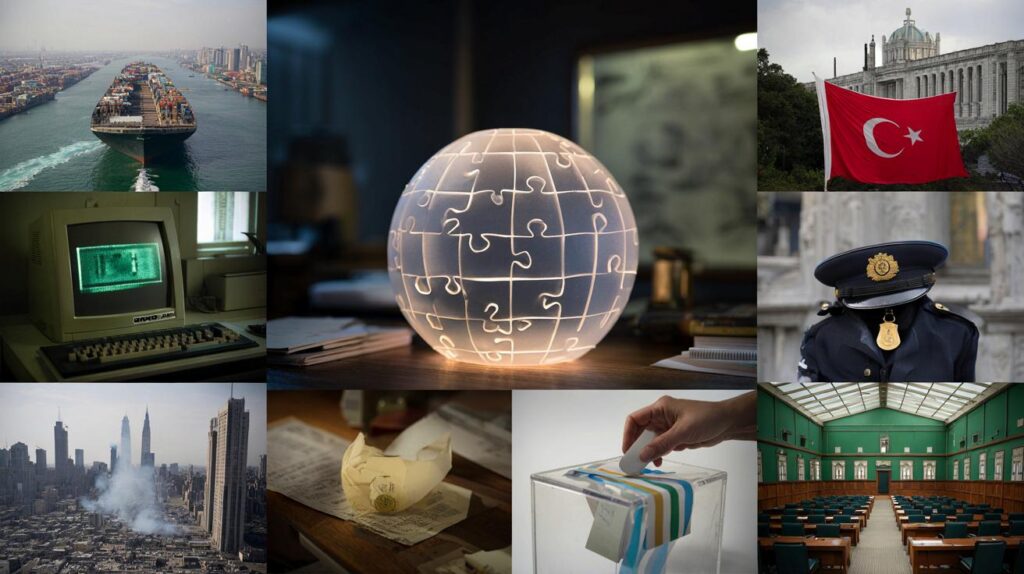
As timelines melt into each other, one quiet homepage stitches wars, films, elections and a 56-year-old tech milestone together.
Today’s selection on Wikipedia threads conflict, culture and memory into a single scroll. It leaps from Gaza to New York cinema, from Sudan’s battlefield to a centenary in Ankara, and lands on the first “login” that birthed the internet age. It reads like a dashboard for your day.
What the front page is saying today
Wikipedia’s curation mixes breaking events with historical echoes. A film uniform sits beside battlefield notes. An Argentine ballot brushes past a French impasse. A soldier’s stubborn stand in 1940 shares space with a 1969 message that travelled between Los Angeles and Stanford. The menu looks eclectic. It signals patterns.
Five flashpoints sit side by side: Gaza, Sudan, Syria, Serbia and a domestic crisis in France. The map crowds fast.
Editors also surface a centenary of statehood in Turkey, a Suez rulebook from 1888, and a mid-century invasion that redrew global alliances. Together, they sketch a long arc: canals, wars, borders, networks, and the people who carry the costs.
War and power: the conflicts stacked together
The Gaza war anchors the feed, with spillover noted in Syria. Sudan’s page line references the Rapid Support Forces, a reminder that Africa’s third-largest country remains split by artillery and hunger. Serbia appears for protests. France appears for political deadlock. None of these items lives in isolation.
- Gaza and Syria: one theatre bleeds into another, pulling diplomacy in two directions at once.
- Sudan: the Rapid Support Forces gain attention as battles grind on and cities empty.
- Serbia: crowds push back, and policing choices face scrutiny.
- France: a crisis at home reshapes budgets, bills and patience.
When five stories collide on one page, you are looking at pressure on energy prices, migration paths, and aid pipelines.
Use the page as a compass, not a destination. Click into citations. Check dates. Scan talk pages for disputes. You will spot what changed overnight and what stayed stubbornly the same.
Ballots and budgets: a midterm in Argentina, a vote in Ireland
Argentina’s midterm line highlights La Libertad Avanza, the movement around President Javier Milei. Midterms decide committee chairs, calendars and the speed of reforms that meet your grocery bill through currency shocks and commodity links. Another line notes Catherine Connolly’s election, a quieter parliamentary shift that still nudges agendas and staffing across committees.
Parliaments move by inches until a tally tips. Wikipedia captures these inches, often before a front-page splash elsewhere. Track the revision history to see how numbers firm up across hours.
Memory that bites: the “did you know” strip
Today’s snippets reward a slow read. Nine French soldiers at the Pont‑Saint‑Louis outpost held their line for two days after the 1940 armistice. A suburban station took its hyphen from a brake maker. Philosopher Bernard Stiegler once framed Alan Greenspan as a “proletarian,” a provocation about labour, knowledge and the tools that use us back.
Nine men held an exposed position for forty‑eight hours after leaders signed the paper that should have ended their fight.
The strip also nods to live editorial work. It reminds newcomers to keep a cool tone, to test admissibility, and to ask questions in public spaces. That invitation looks small. It builds the whole project.
Cinema on the front page: a French cop in New York
“Le Gendarme à New York” lands as the featured article. The 1965 comedy, directed by Jean Girault, sent Ludovic Cruchot across the Atlantic and etched a certain vision of America into a European franchise. A New York police cap, badge and whistle sit today in the Louis de Funès museum at the Château de Clermont, a tangible bridge between screen myth and physical memory.
Culture articles on the main page do more than entertain. They seed context for diplomacy, slang, and stereotypes that still shape negotiations, tourism and business. When a prop survives in a château display case, it says something about what audiences keep—and why.
A century and a login: today’s anniversaries
| Year | Event | Why it matters now |
|---|---|---|
| 1888 | Convention of Constantinople on Suez Canal passage | Suez still steers freight rates, insurance, and detours that set retail prices. |
| 1914 | Battle of the Yser begins | Flooded plains, dug-in lines and a lesson in how terrain stops armies. |
| 1923 | Birth of the Republic of Turkey; capital moved to Ankara | Modern Turkey turns 100+ years, with Ankara central to policy and identity. |
| 1956 | Israeli forces enter Gaza and Sinai during the Suez Crisis | Great-power guarantees met regional aims; the template echoes today. |
| 1969 | ARPANET sends “login” from UCLA to Stanford | Fifty-six years on, your phone rides the descendants of that first hop. |
From canals to packet switches, infrastructure is policy. It governs what arrives, and when, and at what cost to you.
The necrology roll: names, dates, and the pace of loss
The necrology for late October lists a cluster of figures across arts, sport and politics, including James Senese, Jean Blanchard, Prunella Scales, and others curated for the 26th to the 29th. It marks a human rhythm that never pauses as wars blaze and ballots shuffle. The list is not just an obituary stream. It is a research prompt. It asks what to read, what to archive, and which recordings to rescue before links rot.
- Scan dates for patterns: national holidays, seasons, tours, tournaments.
- Open talk pages when entries change quickly.
- Cross-check with references that give times, places and family statements.
How you can act in 10 minutes
Wikipedia’s own navigation spells the path: a community hub, how‑to pages, thematic portals, founding principles, help summaries, and a place to ask questions. Start small and stay polite. Fix a date. Add a citation. Note a missing result in a table. Each micro‑edit builds the next reader’s trust.
- Check the “help” summary, then open “how to contribute”. Pick one fix.
- Use a portal to find a topic you actually know.
- Ask a question on a talk page when a rule confuses you.
- Remember the founding principles: neutral tone, verifiable sources, no private research.
Quick safety checks before you rely on a page
- History tab: look for rapid edits after big news. That often flags disputes.
- Talk tab: scan for warnings, protection notices, and unresolved points.
- References: prefer pieces with publication dates, authors and archive copies.
- Lead section: compare its claims with what the body actually cites.
- Date stamps: events change within hours; note when a fact last updated.
Further angles you can use today
Try a quick simulation: take one anniversary from the table, like the 1888 Suez convention. Map how a blockage raises marine insurance premiums, pushes ships around the Cape, and nudges supermarket prices where you live. Note the lag between the incident and the shelf label. That lag is a reporting window that you can watch in trade data and port queues.
Consider a related activity: checked edits on conflict pages. Pick a detail with measurable outcomes—ceasefire dates, crossing openings, aid convoys. Add a source from a primary channel with time stamps. The risk is vandalism and coordinated messaging in the first 24 hours. The advantage is transparency: diffs, archived links, and a public log you can point to when someone asks, “Where did that come from?”



Loved this dashboard-style write-up. The hopscotch from Gaza and Sudan to a French cop in New York, then all the way to ARPANET’s first “login,” actually makes the front page feel like a single narrative rather than a collage. The tip to check talk pages and revision histories is gold; too many people treat the lead as gospel. Thanks for nudging readers toward diffs and archives—defnitely the bit most folks skip.